AI leverage warning: Big Tech’s bond issuance share rises from 0.5% to almost 10% — and Korean chips?
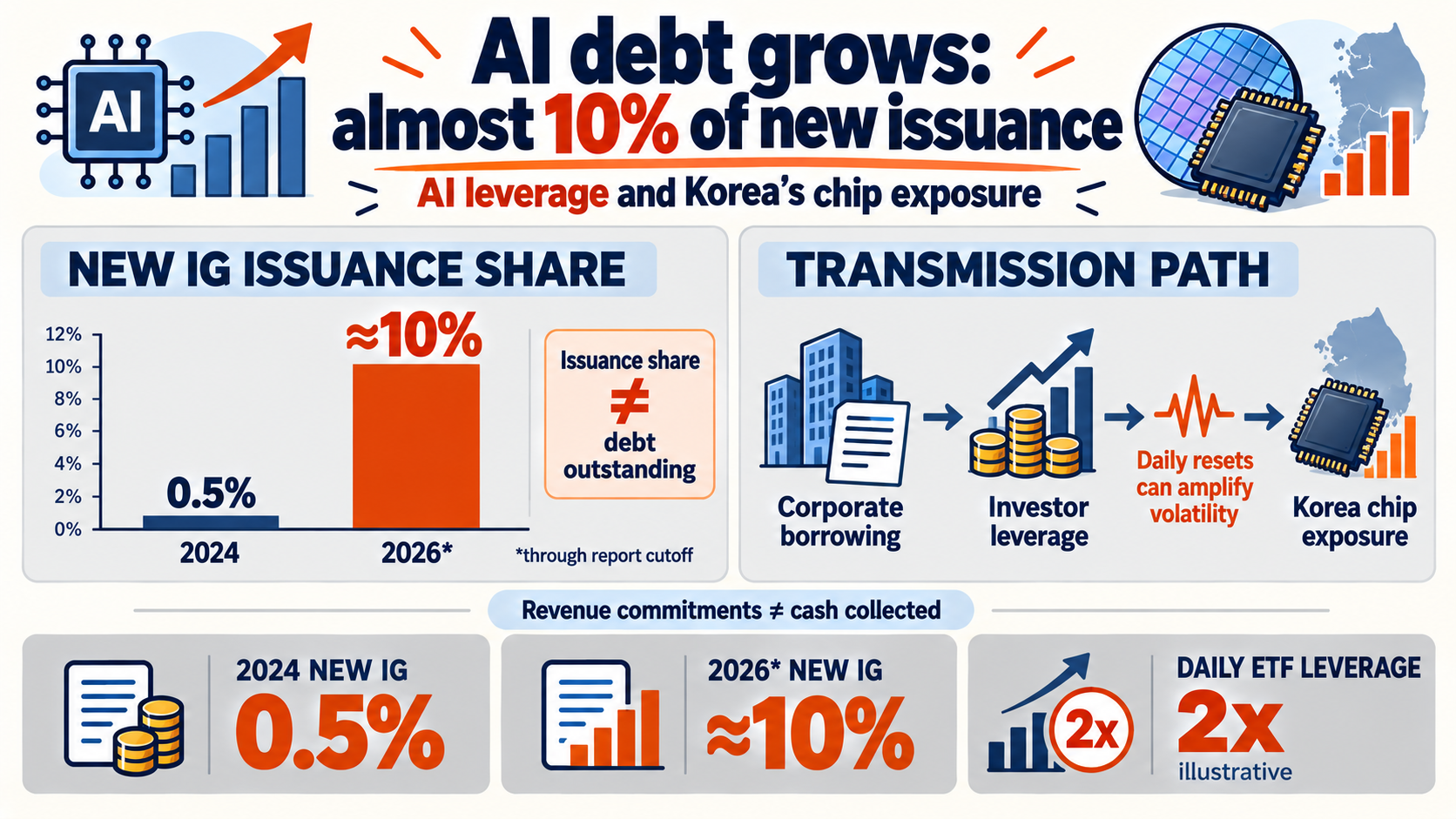
AI leverage can become a problem even while companies remain profitable. The IMF’s October GFSR puts hyperscalers at almost 10% of global investment-grade corporate bond issuance so far in 2026, versus 0.5% in 2024. For Korean chip investors, the question is how investment turns into cash—and how trading structures react when prices fall. Source: IMF Background Analysis 1.1
AI leverage: why profitable companies borrow more
Hyperscalers operate vast cloud infrastructure. This analysis covers Alphabet, Amazon, Meta, Microsoft and Oracle. Investment grade describes relatively strong credit quality; it does not guarantee stable bond or share prices. Source: IMF 표본 정의
The denominator is new investment-grade corporate bond issuance. It is neither outstanding debt nor the share of capital expenditure funded by borrowing. The comparison also uses full-year 2024 and a partial-year 2026 observation, not two annual issuance totals.
Share of new global IG corporate issuance. IMF Background Analysis 1.1, p.2. Partial-year 2026; 10 represents approximately 10%. Not outstanding debt.
A data center has a timing problem. Servers and power capacity require money up front, while customer payments arrive over time. Accounting profit can rise even as cash left after investment becomes tight. Borrowing bridges that gap. This is a cash-flow interpretation, not evidence of imminent default.
The economic implication is a higher hurdle for new projects. Investors absorbing more debt may demand a larger credit spread, the yield above a government-bond benchmark. That raises the cost of fresh financing. It does not instantly change interest payments on existing fixed-rate debt.
The IMF also notes strong balance sheets and liquidity buffers. Rising issuance alone does not establish a default crisis. A more useful question is how much flexibility each company retains if financing becomes less attractive. Source: IMF p.2, 주석 2
$1.4 trillion in commitments: where does end-customer cash come from?
The IMF blog reviews 14 circular arrangements since 2023: roughly $300 billion in equity, $650 billion in debt and $1.4 trillion in future revenue commitments. These describe arrangements, not revenue already earned or projected losses. Source: IMF Blog
Consider an illustrative arrangement, not an allegation about a named company. Cloud provider A invests in AI developer B, which commits to buying computing capacity from A. A is both investor and supplier. The arrangement can work well, but durable demand ultimately requires customers outside that funding relationship to pay B.
-
1
A funds B
Cloud supplier provides capital
-
2
B commits to A
Commitment to buy computing
-
3
Customers pay B
Can B pay without fresh support?
Cancellation rights, usage, actual billing and collections matter alongside contract size. If B reduces consumption, A may face lower expected sales and a weaker equity investment at the same time. Different assets can depend on the same customer’s commercial success. This is a conditional mechanism, not a claim that reported sales are fabricated.
If B builds a paying customer base and finances its own computing bill, early funding has helped create productive capacity. Circularity by itself does not prove distress. The test is whether external customer receipts can sustain the arrangement without repeated supplier support.
How an earnings miss turns into leveraged-ETF selling
Prices can fall because expected earnings decline or because investors pay less for each unit of earnings. In a simple hypothetical example, earnings per share fall from 10 to 9 while the price/earnings multiple stays at 20. The implied price falls from 200 to 180. No change in the multiple is required for that 10% decline.
A daily 2x ETF adds a trading rule. It targets twice the underlying asset’s daily return. The SEC explains that this does not promise twice the cumulative return over longer periods. Even an investor who pays cash for ETF shares can hold a fund that obtains amplified exposure through derivatives. Source: SEC 투자자 교육자료
Take a hypothetical fund with no fees, financing costs or investor flows. Net assets of 100 support exposure of 200. After a 10% fall, exposure is 180 and net assets are 80. Restoring 2x leverage requires exposure of 160: a reduction of 20. The rule can require selling after a decline even without a new discretionary forecast.
Before
100
NAV
Exposure · 200
After decline
80
NAV
Exposure · 180
Reset target
160
2 × 80
Reduce by · 20
Real funds use swaps, futures and dealer hedges, so the entire adjustment need not appear as cash-equity sales at the close. Offsetting trades and investor flows matter. The crucial ratio is required adjustment relative to available liquidity. The IMF discusses Korea as a case where leveraged ETFs intersect with semiconductor concentration. Source: IMF 한국 사례
Korea faces a fast market channel and a slower orders channel
The following is our conditional application to Korea. Equity prices can react first. A global portfolio cutting AI exposure may reduce Korean chip holdings despite strong current profits. Cash and futures trading can coincide with currency conversion, potentially weakening equities and the won together. Not every foreign sale produces a dollar purchase; hedging and reinvestment matter.
Orders can respond more slowly. Delayed data-center expansion could affect incremental orders for high-bandwidth memory, which feeds data quickly to AI processors. Existing contracts need not vanish when new expansion is deferred. Supplier earnings depend on delivery timing, product prices and contract terms as well as order volumes.
Once capacity is installed, depreciation and some labor costs remain even if sales soften. Lower output can increase fixed cost per unit. Unstarted projects offer more room to defer spending. If cash-rich incumbents keep investing while funding-dependent entrants retreat, investment and market share may become more concentrated. These are scenarios, not company earnings forecasts.
Households create another link. Portfolio losses may lead some families to postpone cars or travel, spreading the effect beyond exporters. A weaker won can increase the translated value of dollar sales while also raising imported equipment costs and dollar-debt burdens. Currency depreciation therefore does not affect every chip producer in the same way.
Our earlier discussion of AI exports and East Asian concentration examined where export gains accumulate. This article adds how those industries are financed and held in portfolios. Strong export releases can coexist with an earlier adjustment in financial prices.
What the IMF and Microsoft say, and why sentiment gauges diverge
At the October 13 GFSR briefing, IMF Monetary and Capital Markets Department Deputy Director Athanasios Vamvakidis said strong earnings and growth had supported risk appetite, but resilience did not establish safety. The relevant distinction is between productive investment and the financial system’s ability to absorb disappointment. Source: IMF GFSR 브리핑
On July 29, Microsoft CFO Amy Hood highlighted quarterly cloud revenue of $59.3 billion, up 27% year over year. That is evidence of an operating business, not merely a promise. The same release lists the possibility that substantial investments fail to achieve expected returns. Total cloud revenue should not be relabeled as AI revenue. Source: Microsoft FY2026 Q4
The positions are compatible. Strong current demand does not settle the return on the next facility. Higher financing costs raise that facility’s hurdle rate. Unlike our earlier article on Treasury-market margin calls, this analysis starts with AI earnings expectations and equity ownership structures, rather than leveraged government-bond trades.
Sentiment is not moving uniformly. CNN’s Fear & Greed Index showed extreme fear at 17.9 on October 16, down 28.5 points from 46.5 a week earlier and 9.4 points from 27.3 a month earlier. GoldKimp’s Korean measure reads greed at 68.0 on October 15. Comparable Korean historical values were unavailable, so no weekly or monthly trend is asserted. Source: CNN 제공 스냅샷
The measures use different methods and dates; their gap cannot be translated into a capital-flow forecast. Still, Korean optimism does not establish equally strong overseas appetite for AI risk. Global exposure reductions deserve separate attention when domestic and overseas signals diverge. Source: GoldKimp 제공 스냅샷
SentimenTrader’s October 15 public post put Smart Money at 0.50 and Dumb Money at 0.49, both neutral. These are public headline readings rather than live official data, so treat them as a reference point. They still show that sentiment gauges need not agree. Source: SentimenTrader 공개 게시물 미러
Next earnings: read cash flow, not just revenue
In a constructive scenario, external customer receipts grow, supplier orders hold up and additional financing remains affordable. Korean chip earnings can retain support. In a weaker scenario, collections disappoint while infrastructure spending and financing costs keep rising. Investment retrenchment and financial repricing could then reinforce each other.
At the next quarterly releases, compare operating cash flow with capital spending and ask how contract commitments are converting into usage and collections. For Korean suppliers, follow incremental orders, delivery schedules and prices. For markets, examine foreign cash and futures flows, the won and leveraged-product size together. None alone identifies a turning point.
A useful technology and an attractive investment are connected through price, costs and financing terms. Even investors confident in long-run AI growth need to identify the same chip exposure repeated across individual shares, index funds and leveraged ETFs. This is an economic explanation, not an investment recommendation.
Sources and references
- IMF — October 2026 GFSR
- IMF — Background Analysis 1.1: Rising Leverage in the AI Ecosystem, pp. 2–7
- IMF Blog — AI, Bond Yields, and Cyberattacks (표시일 2026-10-13)
- IMF — 2026-10-13 GFSR briefing (posted 10-14)
- Microsoft — FY2026 Q4 earnings, 2026-07-29
- SEC — Leveraged and Inverse ETFs, 2023-08-29
- CNN — Fear & Greed (제공 스냅샷 2026-10-16)
- GoldKimp — KOSPI F&G (제공 스냅샷 2026-10-15)
- SentimenTrader — 공식 홈페이지, 수치 표시 미확인
- SentimenTrader 공개 게시물 미러 — 2026-10-15 Smart/Dumb Money
For information only — this is not a recommendation to buy or sell any asset.
Comments 0