ECB president candidates de Cos and Knot: rates and euro risk for Korean firms
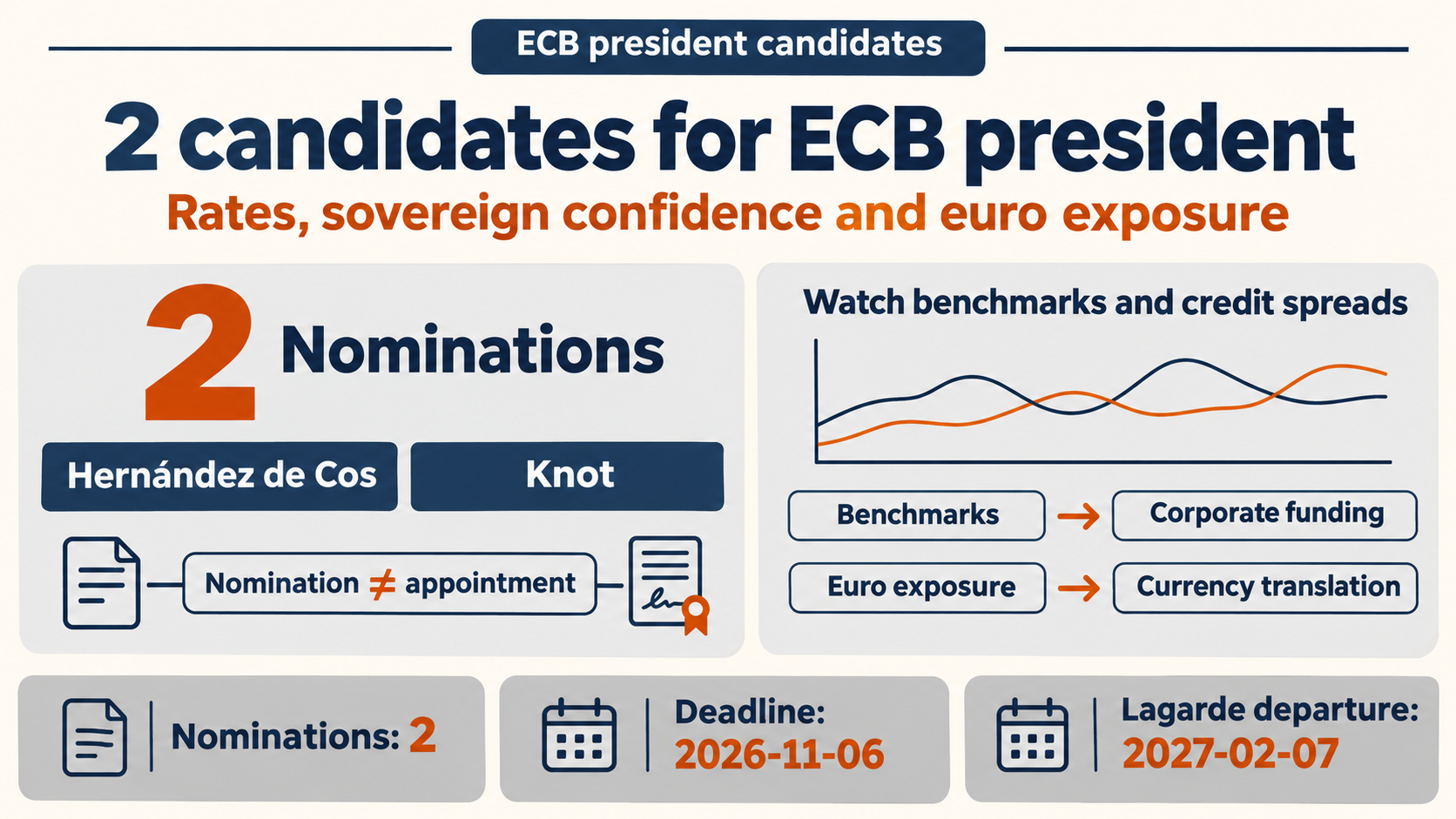
Two candidates have entered the ECB presidential nomination process. On November 6, the Eurogroup announced nominations for Spain’s Pablo Hernández de Cos and the Netherlands’ Klaas Knot. For Korean businesses, the stakes include borrowing costs in Europe and the won value of euro receipts. Source: Eurogroup · 후보 접수 발표, 2026-11-06
This article uses the November 6 nomination announcement as its event baseline. The scheduled November 9 Eurogroup discussion is a next step, not an appointment result. The business implications below are conditional analysis.
ECB president nominations are only the first step
The ECB announced on October 29 that Christine Lagarde would step down on February 7, 2027. That triggered the succession process. The announcement does not give a reason for her departure or announce a French presidential bid. Those claims should not be inferred from the resignation notice. Source: ECB · 라가르드 퇴임 발표, 2026-10-29
The Eurogroup brings together euro-area finance ministers. Discussion there is followed by a Council recommendation and consultation with the European Parliament and the ECB. National leaders in the European Council make the appointment. Official guidance specifies support from at least 16 of 21 euro-area countries representing at least 65% of its population. Source: EU 이사회 · ECB 집행이사회 임명 절차
-
1
Nominations
Two on November 6
-
2
Eurogroup / Council
Discussion and recommendation
-
3
Consultation
ECB and Parliament
-
4
European Council
Final appointment
Two nominations mean the succession has become concrete. They do not give either contender control over monetary policy. A president shapes consensus and communication, while rate decisions belong to the Governing Council. Source: EU 이사회 · ECB 집행이사회 임명 절차
De Cos and Knot: the policy tests in their public remarks
In his June 28, 2026 speech, BIS General Manager Hernández de Cos stressed price stability and rebuilding fiscal buffers. He also called for temporary, targeted and readily reversible liquidity backstops. His nationality is not evidence of a promise to cut rates or support sovereign debt unconditionally. Source: BIS · Hernández de Cos 연설, 2026-06-28
In an April 23, 2025 speech as Dutch central bank governor, Knot described a data-dependent, step-by-step policy approach. He also argued that more integrated European capital markets could support corporate financing and investment. This is historical evidence of his thinking, not a platform submitted for the current nomination. Source: DNB · Klaas Knot 연설, 2025-04-23
Useful comparisons concern how each assesses temporary inflation versus persistent wage and service-price pressure, and fiscal deterioration versus disorderly trading. The available statements do not justify assigning either candidate a rate path or a probability of using TPI.
The IMF’s July 16, 2026 euro-area consultation described an energy shock that raised inflation risks while weakening the growth outlook. This is a July assessment, not a new November forecast. It illustrates the policy dilemma: tightening against price pressure can further weaken household spending and business investment. Source: IMF · 유로지역 연례협의, 2026-07-16
Policy rates and sovereign spreads move separately
Policy rates influence financing across the euro area, but countries and companies still pay different borrowing costs. Investors demand extra compensation for credit and liquidity risks. This spread can be tracked through measures such as the gap between French and German government yields at comparable maturities.
Wider sovereign spreads can hurt banks holding government bonds and raise their own funding costs. Tighter lending then affects smaller companies and households. This connects the succession to our earlier discussion of French sovereign stress and corporate financing.
The Transmission Protection Instrument, introduced on July 21, 2022, protects the transmission of monetary policy. It allows purchases against unwarranted, disorderly market dynamics. Eligibility assessments include fiscal sustainability; it is not an unconditional ceiling on a country’s borrowing costs. Source: ECB · TPI 도입과 요건, 2022-07-21
Policy rates
Influence aggregate demand and inflation
·
· · Affect borrowing, spending and investment
TPI
Address unwarranted market disorder
·
· · Subject to eligibility assessments
Inflation restraint and restoring market functioning may be needed at the same time. Credible communication could reduce compensation demanded for unnecessary uncertainty. Doubts about the boundary between fiscal support and monetary policy could instead raise long-term risk premiums. These are possible mechanisms, not measured reactions to the nominations.
Risk appetite differs across markets. The supplied CNN snapshot shows extreme fear at 22.1 on November 6, down 4.2 points from 26.3 a week earlier and 24.9 from 47.0 a month earlier. GoldKimp’s Korean gauge shows extreme greed at 78.7 on November 5; comparable Korean weekly and monthly readings are unavailable. Source: CNN Fear & Greed · 2026-11-06 스냅샷 Source: GoldKimp KOSPI · 2026-11-05 스냅샷
The two gauges differ in methodology and date; their gap does not measure capital flows. The SentimenTrader public page checked on November 9 displayed neither Smart Money/Dumb Money values nor an update date. US risk aversion may amplify funding pressure if European policy credibility falters, but it does not establish euro depreciation. Source: SentimenTrader · 2026-11-09 열람, 값 미표시
For Korean companies, net euro cash flow matters
A weaker euro against the won reduces translated euro revenue, but also lowers the won value of euro expenses. The relevant exposure includes net receipts after euro costs, existing hedges and payment dates. A fall in EUR/USD alone does not determine the result in won.
Consider a hypothetical company with annual unhedged net receipts of €10 million. At KRW 1,500 per euro, these are worth KRW 15 billion. A 5% decline to KRW 1,425 reduces that to KRW 14.25 billion, a KRW 750 million difference. This holds volume and prices constant and is not an exchange-rate forecast.
Won value of €10m net receipts. Unhedged, fixed volume. KRW 1,500 → 1,425 is hypothetical. · Axis starts at 130, not zero
Korean exporters may try to raise local prices to offset currency losses. That can cost market share if European rivals hold prices or customers are under pressure. Local production can align the currency of costs and revenues, but does not remove weak demand or financing risk.
The industrial effects can be uneven. Large groups may match euro earnings with euro investment more easily than smaller suppliers carrying won costs. Persistent pressure could encourage local sourcing or changes in production locations, although productivity, labour and logistics costs remain decisive.
Would lower ECB rates guarantee cheaper corporate debt?
Corporate euro borrowing costs can be viewed as a maturity-matched benchmark plus a credit spread. Policy-rate cuts do not guarantee an equal decline in longer-term benchmarks. An increase in credit spreads can even outweigh a lower benchmark.
In an illustration, a 0.25 percentage-point benchmark decline combined with a 0.50-point spread increase raises the total rate by 0.25 points. On €100 million of new borrowing that adds €250,000 in annual interest. Existing fixed-rate debt does not immediately reprice; refinancing dates and fees also matter.
Marginal capital projects may be delayed, reducing orders for Korean machinery and components. Households may also defer credit-sensitive housing and car purchases. Financing conditions belong alongside the demand picture in our discussion of euro-area growth and Korean exports.
Equity effects may vary by industry. Lower financing costs can support the value of future earnings, but weaker profit expectations may dominate. For banks, bond portfolios, loan demand and credit losses matter alongside lending margins.
What Korean companies should check at the next steps
The scheduled November 9 discussion should first be checked for procedural progress. A recommendation, consultations and a final European Council decision are separate milestones. The reviewed announcements do not establish a binding French-election deadline or candidate-specific bond-support promises.
For Korean companies, reviewing net euro exposure and debt maturities is more useful than changing hedge ratios based on nationality. Hedging stabilises the value of contracted cash flows. Observed EUR/KRW moves and corporate spreads, rather than nomination labels alone, should inform pricing and investment reviews.
The economic significance of this succession is the credibility of containing inflation while preserving market functioning. That credibility can feed into financing and investment decisions. This analysis explains those channels and does not recommend trades in particular assets.
Sources and references
- Eurogroup · 후보 접수 발표, 2026-11-06
- ECB · 라가르드 퇴임 발표, 2026-10-29
- EU 이사회 · ECB 집행이사회 임명 절차
- ECB · TPI 도입과 요건, 2022-07-21
- BIS · Hernández de Cos 연설, 2026-06-28
- DNB · Klaas Knot 연설, 2025-04-23
- IMF · 유로지역 연례협의, 2026-07-16
- CNN Fear & Greed · 2026-11-06 스냅샷
- GoldKimp KOSPI · 2026-11-05 스냅샷
- SentimenTrader · 2026-11-09 열람, 값 미표시
For information only — this is not a recommendation to buy or sell any asset.
Comments 0