Eurozone GDP Grows 0.4%: What France’s Contraction Means for Korean Exports
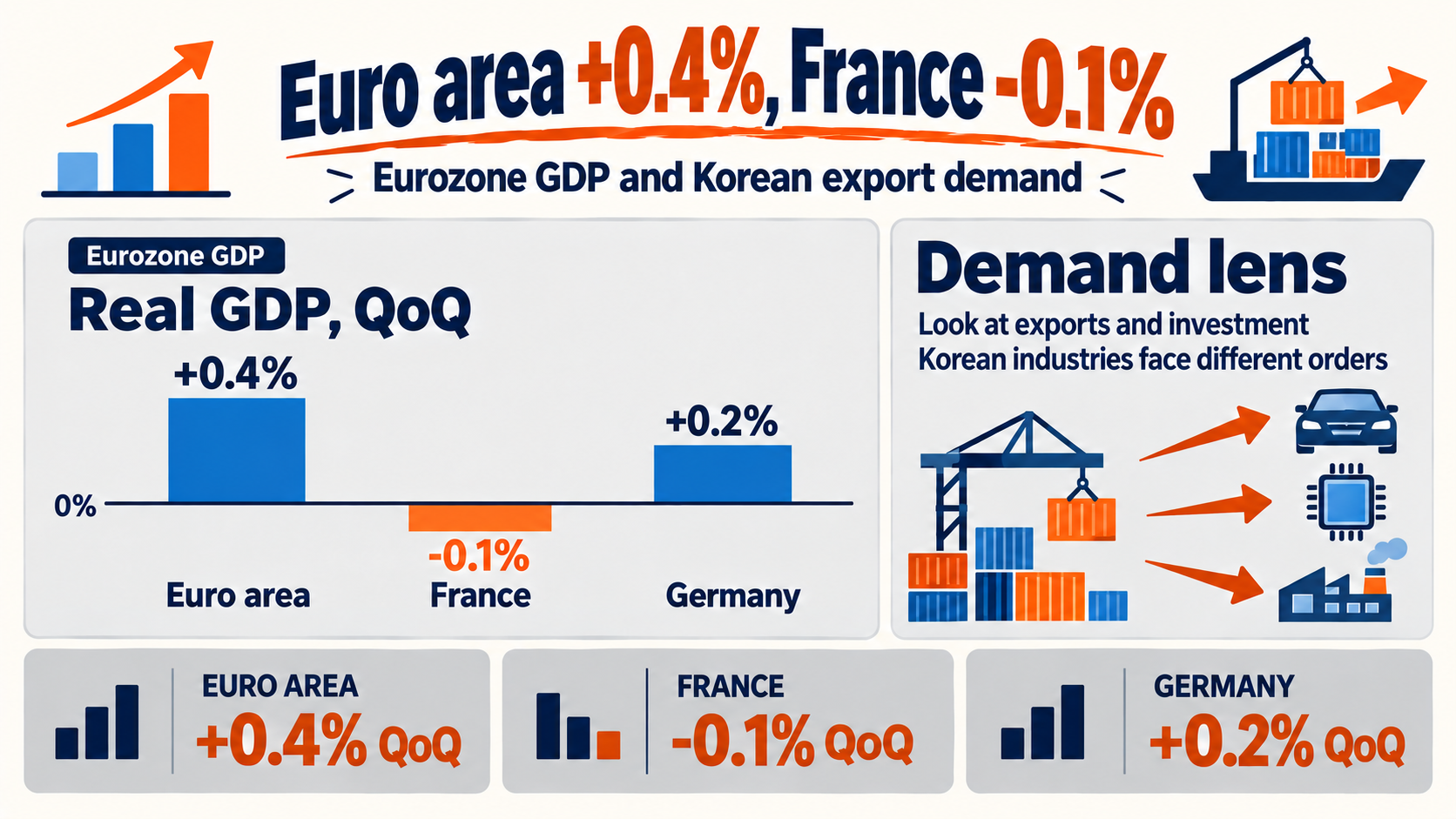
Eurozone GDP rose 0.4% in the third quarter of 2026, while France contracted 0.1%. For Korean businesses, the useful question is where European orders are coming from. Separating consumption, investment and exports reveals different implications for cars, chips and ships. Source: Eurostat — 2026-10-30 유로존·EU GDP 속보
Can Korean exports to the EU rise while parts of Europe struggle? Yes. GDP measures value added within an economy; merchandise exports measure goods sold abroad. They describe different parts of the same economic system.
Eurozone GDP: what the 0.4% average conceals
Germany grew 0.2%, Spain and the Netherlands 0.6% each, Italy was flat and France contracted. These are seasonally adjusted, quarter-on-quarter changes in real output, which remove the effect of price changes. Source: Eurostat — 2026-10-30 유로존·EU GDP 속보
Growth differs across countries
% QoQ · Centre line = zero
The bloc beat the 0.2% forecast in a Reuters poll, but slowed from 0.6% in the second quarter. A positive surprise is not the same thing as an acceleration. Source: Reuters — 2026-10-30 유로존 성장, 예상 상회
Ireland expanded 5.5%. Its multinational-heavy economy can produce GDP movements that differ sharply from household purchasing power. Eurostat flags the experimental nature of the Irish flash estimate. We do not calculate a growth rate excluding Ireland without the necessary weights. Source: Eurostat — 2026-10-30 유로존·EU GDP 속보 Source: Reuters — 2026-10-30 유로존 성장, 예상 상회
France: exports and investment, rather than a collapse in spending
INSEE reported consumption up 0.4%, fixed investment down 0.6% and exports down 1.7%. Fixed investment covers long-lived assets such as buildings and equipment. A pullback can weaken future orders even when current household spending holds up. Source: INSEE — 2026-10-30 프랑스 3분기 국민계정
The contribution arithmetic is revealing: domestic demand excluding inventories added 0.1 percentage point, net exports subtracted 0.6 and inventories added 0.4. Together they give -0.1%. Imports are subtracted because consumption and investment also include foreign-made products. Source: INSEE — 2026-10-30 프랑스 3분기 국민계정
How France arrived at -0.1%
%p · Centre line = zero
An inventory contribution is not proof of strong sales. Goods produced but not yet sold still count as output. Planned stockbuilding and disappointing sales have different implications. If the latter dominates, production cuts and cash tied up in warehouses can delay investment further.
Transport-equipment exports fell 9.1%, with aerospace a major drag, after a 20.8% increase. The 9.1% figure is not an aircraft-only measure. Large deliveries can shift quarterly results, but these accounts do not establish a particular cancellation or manufacturer delay. Source: INSEE — 2026-10-30 프랑스 3분기 국민계정
Direction matters too. French aircraft exports concern sales to customers abroad. They do not measure French purchases of Korean cars. Treating weaker exports as evidence that every category of imports must decline would misread the data.
Korean exports to the EU: separate value from final demand
The verified September figure is $8.65 billion in Korean exports to the EU, up 20.9% from a year earlier, according to the ministry release dated October 1. This monthly nominal measure is not directly comparable with quarterly real GDP. The EU-27 and euro area also cover different countries. Source: 산업통상부 — 2026-10-01 발표, 9월 수출입 동향
Export value combines quantity, prices and product mix. It can rise without a matching increase in unit volumes. Components shipped to Europe may also be assembled into products sold elsewhere. Customs exports alone cannot establish that European households have become better off.
Cars
Spending and financing
·
· · Registrations and discounts
Chips
Customer investment purpose
·
· · Prices, volumes, inventories
Ships
Existing contract deliveries
·
· · New orders and payment terms
For cars, local registrations and selling terms both matter. Resilient spending can support orders, while expensive financing and running costs can postpone purchases. Discounts or subsidised financing may protect unit sales at the expense of profit. Cars made in European factories are not Korean customs exports.
For chips, end use is crucial. Data-centre memory and automotive or industrial semiconductors depend on different buyers. AI projects can sustain orders even when broader investment slows. But rising prices alongside customer inventories would make expansion riskier. These are conditional business mechanisms, not earnings forecasts derived from GDP.
Shipbuilding works on a longer clock. Current deliveries reflect contracts signed earlier. A slowdown need not immediately reduce delivery values. New orders depend more on freight expectations, financing and fleet replacement. Payment milestones matter when judging how a backlog turns into cash.
This extends our earlier analysis of Korea’s uneven September export performance. Higher aggregate exports do not imply that orders and margins improve across every industry. Within Europe, buyer location and the purpose of a purchase add another layer.
What Lagarde and Lescure said: supportive spending meets rising costs
On October 29, ECB President Christine Lagarde identified AI investment and public infrastructure and defence spending as supports, alongside energy and financing pressures. The IMF’s October 13 outlook highlighted difficulties for energy importers outside technology value chains. Exposure to growing industries helps explain uneven resilience. Source: ECB — 2026-10-29 통화정책 설명과 질의응답 Source: IMF — 2026-10-13 세계경제전망
French Economy Minister Roland Lescure described an economy stalled by combined internal and external shocks in an October 30 franceinfo interview reported by Reuters. That assessment provides context; it does not identify how much each shock contributed to GDP. Source: Reuters — 2026-10-30 프랑스 역성장과 경제장관 발언
Higher energy costs force a choice: pass them to customers or absorb them in margins. The former strains purchasing power; the latter reduces investment resources. The ECB held rates on October 29 without committing to a future path. Weak growth alone does not guarantee cheaper credit. Source: ECB — 2026-10-29 통화정책 설명과 질의응답
Currency exposure is a separate issue. A weaker euro against the won reduces translated revenue, but euro-denominated costs or exchange-rate hedges can offset part of the effect. Matching the currencies and maturities of revenue, costs and debt is more useful than predicting exchange rates from GDP alone.
This is the next link in the story of French sovereign yields and business financing: how financing pressure reaches equipment orders and consumption. Equity prices depend on both expected earnings and the discount rates used to value them. A GDP beat cannot guarantee a stock-market gain.
CNN’s US Fear & Greed index stood at 26.2, in fear territory, on October 30: up from 16.7 a week earlier but still below 30.3 a month earlier. GoldKimp’s KOSPI measure was 76.7, extreme greed, on October 29. Different methods and dates prevent a direct score comparison; Korean weekly and monthly history was unavailable. Optimism about Korean exporters still needs to be checked against European customer orders. Source: CNN — 2026-10-30 Fear & Greed 스냅샷 Source: GoldKimp — 2026-10-29 KOSPI 심리 스냅샷
SentimentTrader’s public page did not display Smart Money or Dumb Money Confidence values or an update date when checked. We therefore draw no conclusion about a divergence between those measures. Sentiment cannot substitute for orders or business cash flow. Source: SentimentTrader — 공개 페이지 확인, 수치·날짜 미표시
Two paths to test in the November revisions
Eurostat schedules its next GDP estimate for November 13 and main aggregates including employment for December 7. France’s detailed accounts are due November 27. Flash estimates can be revised. Watch whether the composition of spending and inventories holds up. Source: Eurostat — 2026-10-30 유로존·EU GDP 속보 Source: INSEE — 2026-10-30 프랑스 3분기 국민계정
A rebound in transport exports alongside stabilising investment would make delivery timing a more plausible explanation. Persistent export weakness and accumulating inventories would raise the risk of production and hiring adjustments. These are paths to test, not established outcomes.
For Korean businesses, European revenue share alone is insufficient. Check vehicle discounts and inventories, chip customers’ investment execution and order volumes, and shipbuilders’ new contracts and payment terms. What customers buy and when they pay is closer to earnings than the regional GDP headline. This analysis is not a recommendation to buy or sell an asset.
Sources and references
- Eurostat — 2026-10-30 유로존·EU GDP 속보
- INSEE — 2026-10-30 프랑스 3분기 국민계정
- Reuters — 2026-10-30 유로존 성장, 예상 상회
- Reuters — 2026-10-30 프랑스 역성장과 경제장관 발언
- 산업통상부 — 2026-10-01 발표, 9월 수출입 동향
- ECB — 2026-10-29 통화정책 설명과 질의응답
- IMF — 2026-10-13 세계경제전망
- CNN — 2026-10-30 Fear & Greed 스냅샷
- GoldKimp — 2026-10-29 KOSPI 심리 스냅샷
- SentimentTrader — 공개 페이지 확인, 수치·날짜 미표시
For information only — this is not a recommendation to buy or sell any asset.
Comments 0