Fed Rate Hike 2026 — Jackson Hole 57% Odds, Core PCE 3.3%, What About the BOK?
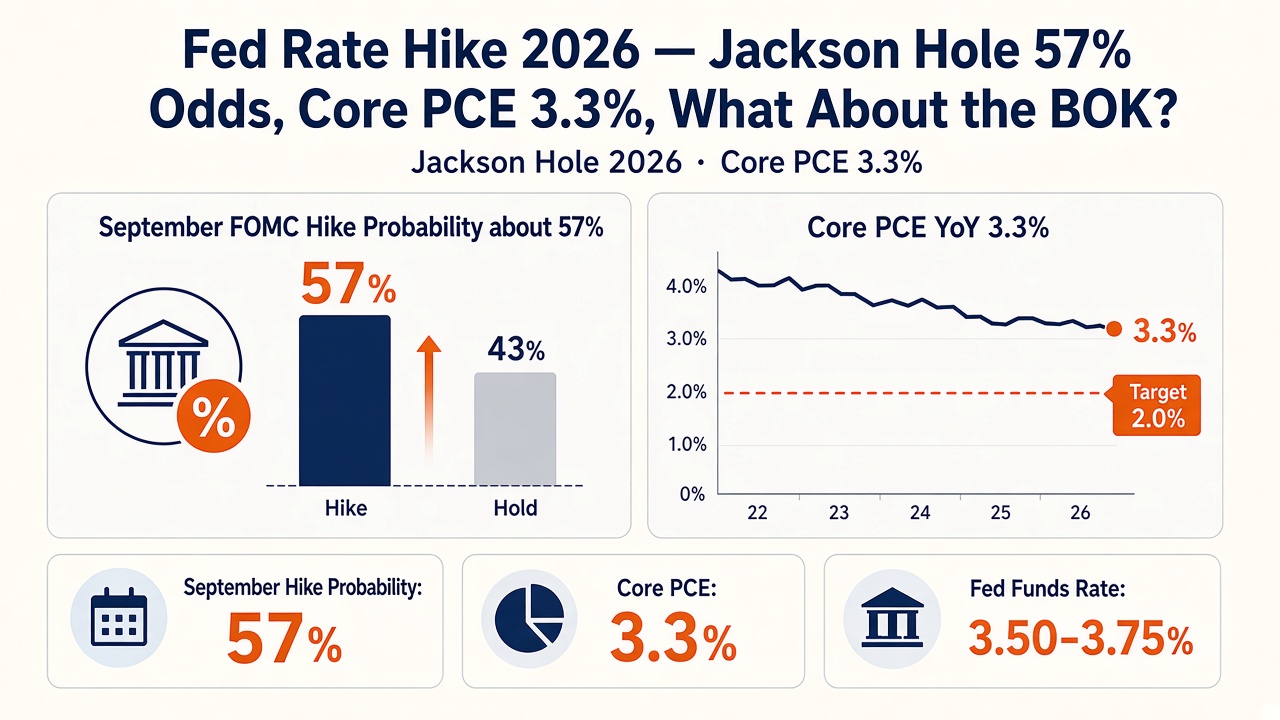
Fed rate hike 2026 talk moved forward after Chair Kevin Warsh’s August 28 Jackson Hole speech. He said the Fed has “work to do” if underlying inflation is not clearly heading to the 2% target. CME FedWatch-style pricing put the odds of a 25bp September hike near 57% after the remarks, up from roughly 35–40% before. In the same week, July core PCE held at 3.3% year over year — the Fed’s preferred gauge has been above 2% for 65 straight months.
This post explains why hikes are back on the table, what the 57% figure actually prices, and what Bank of Korea Governor Shin Hyun-song meant by rejecting a mechanical follow. We separate confirmed facts (BEA PCE, FedWatch odds) from forecasts (e.g., Goldman’s September hold base case). Educational only — not investment or FX advice.
What shifted at Jackson Hole — Fed rate hikes 2026 back on the table
Jackson Hole is the Fed’s late-August symposium where chairs often telegraph policy. Warsh deliberately avoided a classic forward-guidance speech: no explicit reaction function, no dated promise. But two lines were clear: inflation remains above the 2% PCE target, and without confidence that underlying inflation is moving to objective “clearly and at sufficient speed,” the Fed has work to do.
The funds rate target range has been 3.50%–3.75% since December 2025. Warsh added that credit and loan markets show “few signs of policy restraint” at that level — markets read that as leaving hikes on the table if inflation sticks.
Start with the inflation print — core PCE at 3.3%
PCE is the Commerce Department’s monthly inflation gauge and the Fed’s official targeting metric. Core PCE strips food and energy to track the slower-moving “body” of inflation. In July 2026, headline PCE ran 3.7% year over year and core 3.3%, each up 0.2% month over month.
Summer monthly prints beat some fears, but the distance to 2% is still large. Goods prices edged down month over month while services rose 0.3% — financial services, insurance, and housing costs are sticky. Goldman Sachs noted 54% of the PCE basket rose more than 3% over the past year versus a pre-pandemic norm near 32%, with tariffs still in the mix for some goods.
July PCE headline 3.7% vs core 3.3% vs Fed 2% target bar chart. BEA release 2026-08-26. Headline and core are year-over-year %.
Real consumer spending was nearly flat in July even as incomes rose — households are not overheating, but the Fed still has language to stay hawkish on prices.
What 57% means — FedWatch and the rate path
Fifty-seven percent is not Warsh promising a September hike. It is futures-implied probability on the September 15–16 FOMC meeting. Press reports put pre-speech odds near 35–40% and post-speech near 57%. Traders also priced roughly 70% for October and nearly 90% cumulative odds of hikes by December — inference from market pricing, not a Fed forecast.
September Fed hike odds near 57% after Jackson Hole bar chart. Futures-implied (CME FedWatch). Pre/post speech from press aggregates (~40%→57%).
Goldman Sachs still leans hold in September if August core inflation runs near 0.2% month over month, but opens the door to a hike on hotter CPI/PPI. U.S. stocks fell and Treasury yields rose on August 28 as that repricing hit.
How a hike transmits through the economy
A Fed hike raises short-term funding costs, often pulling corporate, mortgage, and market rates along. Higher U.S. yields can attract global capital and strengthen the dollar — relevant for import prices and emerging-market flows.
-
1
1. Fed funds hike
Higher short rates and bank funding costs
-
2
2. Treasuries & loans
Corporate and mortgage rates may rise
-
3
3. Dollar yield appeal
Capital may shift toward U.S. assets
-
4
4. Stronger USD · imports
Oil and commodities priced in dollars
-
5
5. Korea — rates · FX · flows
BOK weighs FX and stability, not automatic match
Korea already lifted its policy rate to 3.00% on August 27, which can narrow the Korea–U.S. gap and support the won, but further hikes also raise domestic interest burdens. The BOK is signaling data-dependent pacing rather than mirroring every Fed move.
Bank of Korea — why “not mechanical” matters
Governor Shin called Warsh’s speech a meaningful hint for September FOMC, yet said Korea will not automatically match U.S. hikes — FX, financial stability, and domestic growth all count. USD/KRW closed near 1,372.5 on August 28 despite a stronger dollar index; Shin described improved won “resilience.” The August MPC statement dropped language about continuing the hiking stance, and the dot plot read less hawkish than some expected.
Global backdrop — IMF’s tug-of-war
IMF Managing Director Georgieva on August 25 framed a tug-of-war: Middle East energy shock versus an AI investment boom. July WEO projects 2026 global growth at 3.0% and headline inflation at 4.7%. She warned fiscal pressures and stalled disinflation may keep central banks tight — aligned with Warsh’s tone, though AI capex could split sector outcomes.
September dates that split fact from forecast
- September 11 (expected) — U.S. August CPI
- September 15–16 — FOMC decision
- September 30 (expected) — August PCE from BEA
Analysts note Warsh faces political tension around midterms: hiking underscores inflation seriousness but invites executive pushback; holding requires explaining tolerance for 3%+ core PCE. Soft August CPI could justify a September pause under the framework he outlined.
Fed rate hike 2026 — what we know and what depends on September data
Facts: core PCE 3.3%, fed funds 3.50%–3.75%, Warsh’s “work to do” line, ~57% September hike odds post-speech, BOK at 3.00% with non-mechanical Fed follow. Forecasts diverge: markets price more hikes by year-end; Goldman’s base is September hold barring hot data.
Rather than trading the 57% headline alone, watch how the September statement defines progress on inflation — hikes reprice the dollar/rates axis; holds reprice growth and equities.
Related: BOK hike · FX · housing, US market · DXY, USD/KRW breaks 1,500, War economic damage · oil shock. Educational only.
Fifty-seven percent is market pricing — not a promise. Read September CPI before you read the headline.
Sources
- Reuters / Yahoo — Warsh Jackson Hole speech
- CNBC — Warsh on inflation at Jackson Hole
- BEA — Personal Income and Outlays, July 2026
- Reuters — US inflation sticky in July
- Economic Times — FedWatch 57%, Goldman view
- Reuters — IMF Georgieva briefing
- IMF — WEO July 2026 Update
- 머니투데이 — 신현송 총재, 비기계적 대응
- 서울신문 — 잭슨홀·한은·FedWatch
- Business Times — Warsh inflation dilemma
- Internal: 2026-08-31-warsh-jackson-hole-fed-hike-session-01.md
For information only — this is not a recommendation to buy or sell any asset.
Comments 0