MSCI Indonesia Downgrade Consultation: Is a 0.43% EM Weight Good News for Korea?
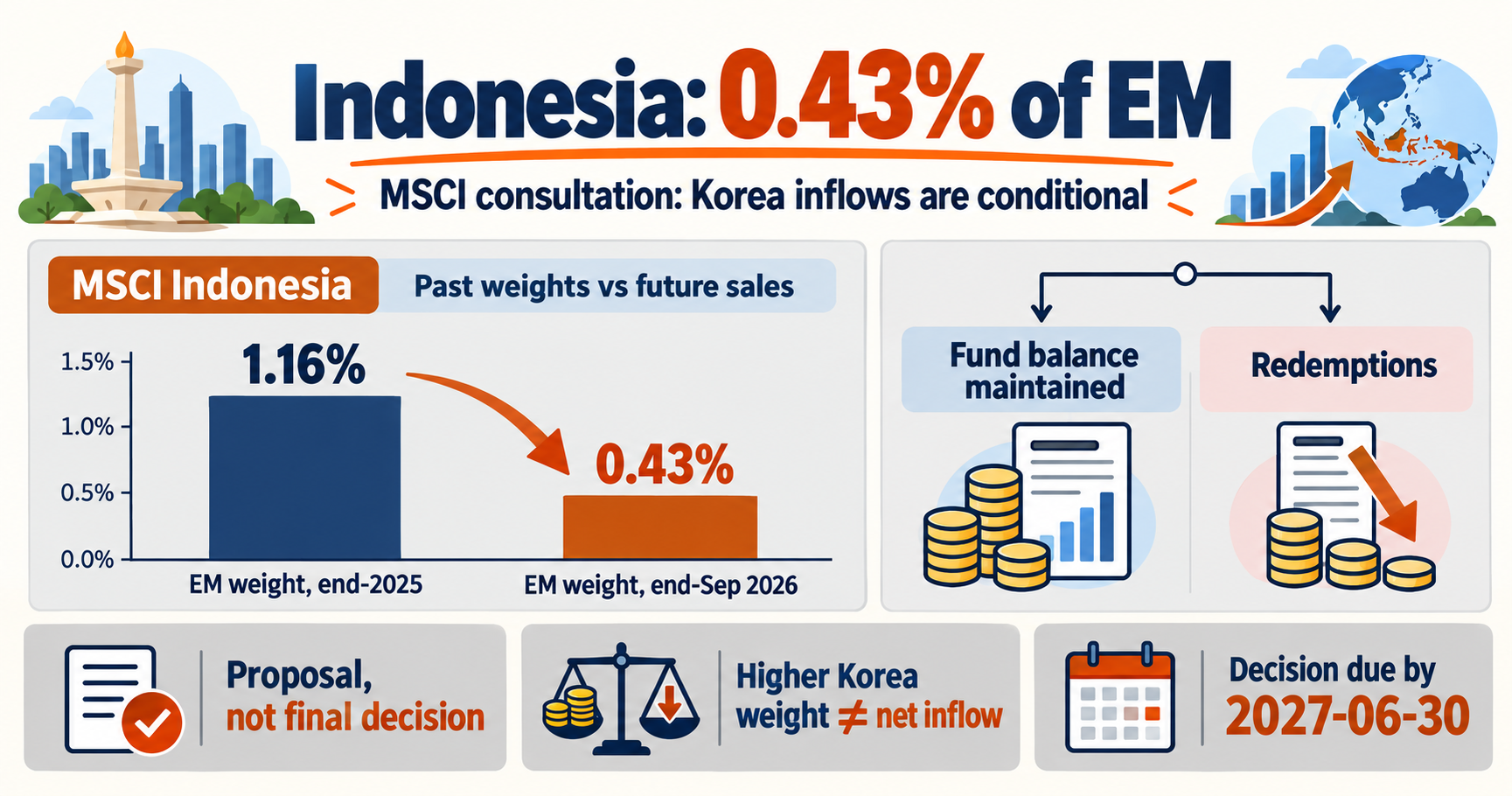
The MSCI Indonesia reclassification consultation has begun. Potential removal from emerging-market indexes can change how funds trade even when company earnings have not changed. For Korean investors, the question is where that money goes. A higher index weight does not necessarily mean more dollars buying Korean shares. Source: MSCI — Indonesia reclassification consultation, 15 Oct 2026
Jakarta shares were down roughly 11% intraday at the time of a Reuters report on October 16. Prices moved before any reclassification took effect. This article separates the confirmed process from conditional flow scenarios, using information checked on October 17. Source: Reuters — Indonesia gets a wake-up call, 16 Oct 2026
MSCI Indonesia reclassification is still a proposal: decision due by June 2027
MSCI proposed moving Indonesia from Emerging Market to Standalone status on October 15. Feedback closes on April 30, 2027, with a decision due by June 30. The decision deadline is not an implementation date. Source: MSCI — Indonesia reclassification consultation, 15 Oct 2026
An index measures a basket of shares held in specified proportions. Passive funds aim to match its returns by aligning their holdings with that basket. Standalone treatment separates the country index from relevant composite indexes. Funds tracking those composites would then have a different investment universe. It would not ban all investment in Indonesian shares.
Active managers choose their own holdings. If their mandates allow it, they could retain Indonesian stocks after benchmark removal. But losses on an off-benchmark position require a separate investment justification. That can encourage managers to reduce exposure before implementation. It is an incentive, not a universal obligation to sell.
-
1
Consultation
Opened Oct 15, 2026
-
2
Feedback
Until Apr 30, 2027
-
3
Decision
By Jun 30, 2027
-
4
Implementation
Timing and staging not yet fixed
Why Standalone rather than Frontier: ownership and trading trust
MSCI cited opaque ownership, suspected coordinated trading and insufficient evidence of effective enforcement. Participant feedback suggested that Frontier status would not adequately reflect the problems. This goes beyond an opinion that particular stocks are expensive: it concerns confidence in market functioning. Source: MSCI — Indonesia reclassification consultation, 15 Oct 2026
Free float means the shares potentially available for trading after excluding holdings such as strategic controlling stakes. Index weights depend on more than the size of a company. They also depend on how much investors can buy. Ownership spread across several names can still overstate effective supply if those holders act together.
The discrepancy can become a trading cost. A fund buying to match its benchmark may push prices up if available supply is thin. On a selling day, too few buyers can force a lower execution price. An investable benchmark needs prices at which institutions can realistically trade meaningful quantities.
That is also how reforms should be judged: whether disclosures reveal effective control and whether surveillance produces sustained enforcement. Improvements confined to a few large stocks would leave broader doubts. Investors need information they can trust on the next trading day, not simply a longer list of rules.
The decline from 1.16% to 0.43% has already happened
Page 7 of the consultation shows Indonesia’s EM weight falling from 1.16% at end-December 2025 to 0.43% at end-September 2026, a decline of 0.73 percentage points. These are historical weights, not the prospective effect of the new proposal. Source: MSCI — Indonesia consultation, October 2026, pp. 2–7
Indonesia weight in MSCI EM (%). Source: MSCI consultation, p. 7. Historical weights, not cash outflow rates.
Nor does a falling weight measure cash outflows. A country’s weight is its index-adjusted market value divided by the total. Local price declines, currency depreciation or stronger prices elsewhere can reduce that share without a corresponding cash sale. Constituent and free-float changes matter too.
Estimating sales requires actual tracking assets, the relevant indexes and weights at implementation. The market capitalization of an index is not the assets held by funds tracking it. Treating all benchmark-aware money as passive assets would overstate mandatory sales.
For Korea, watch the size of the fund as well as its weights
Holding everything else constant, removing a 0.43% weight divides each remaining weight by 0.9957. That is a relative increase of about 0.432%, not a 0.432-percentage-point increase in Korea’s weight. The arithmetic applies across the remaining markets, including Korea and Taiwan.
Consider a hypothetical $100 million fund with an illustrative Korean weight of 20%, not an observed current weight. It initially holds $20 million in Korea. Removing Indonesia alone raises that to about $20.086 million if fund assets stay constant, a gain of roughly $86,000. If redemptions shrink the fund by 1%, the Korean holding instead falls to about $19.886 million.
Hypothetical Korean holdings (USD 10,000). Own calculation. Initial AUM $100m, assumed Korea weight 20%, Indonesia 0.43% removed. Prices fixed. Not a forecast. · Axis starts at 1,900, not zero
A bigger slice can still produce fewer dollars if the pool shrinks. Actual trades also depend on prices, derivatives, cash holdings and replication choices. This is an illustration separating reweighting from redemptions, not a flow forecast.
Within Korea, any benefit would also be uneven. Index-matching purchases allocate more to larger constituents. Support for semiconductor and other large-cap shares does not automatically improve the earnings of smaller domestic businesses. This connects with our earlier discussion of Asian AI exports and concentration in Korean equities.
Potential beneficiaries elsewhere in Southeast Asia depend on mandates. An ASEAN-only fund reducing Indonesia may not be permitted to buy Korea. A global EM fund has no reason to reinvest only within Southeast Asia. The fund’s investment universe determines the available destinations.
Warnings from the IMF and a local economist, and split US–Korea sentiment
Josua Pardede, chief economist at Bank Permata, told Reuters on October 16 that measurable improvements in transparency and enforcement should take priority over further reform announcements. In that framework, a one-day price rebound matters less than changes in market practice. Source: Reuters — Investors see outflow and FX risks, 16 Oct 2026
In an official October 13 briefing, Athanasios Vamvakidis, a deputy division chief in the IMF’s Monetary and Capital Markets Department, warned that resilience did not imply safety and existing vulnerabilities could amplify shocks. He was not commenting on Indonesia’s reclassification. His point helps explain why a country-specific shock can worsen during broader risk reduction. Source: IMF — Global Financial Stability Report briefing, 13 Oct 2026
The IMF’s April 7 discussion of nonbank capital also describes how redemptions and benchmark adjustments can synchronize selling. An equity classification change does not automatically trigger sovereign-bond index sales. Bond and currency spillovers require a separate channel through risk appetite and funding. As in our earlier IMF hedge-fund and Treasury analysis, the key is who must sell and under what constraint. Source: IMF — Emerging markets and nonbank capital, 7 Apr 2026
Sentiment gauges add context. CNN Fear & Greed stood at 19.3, extreme fear, on October 16, down 27.2 points from 46.5 a week earlier and 8.0 points from 27.3 a month earlier. GoldKimp’s KOSPI measure was 68.0, greed, on October 15. Comparable Korean week- and month-earlier readings were unavailable. Different methods and dates prevent a precise cross-market score comparison; the useful observation is US risk aversion alongside stronger Korean sentiment. Source: CNN Fear & Greed — 16 Oct 2026 snapshot Source: GoldKimp KOSPI Fear & Greed — 15 Oct 2026
As of October 17, SentimenTrader's public Smart Money/Dumb Money Confidence panel showed neither value nor an update date, so there is no basis here for claiming a split between professional and retail investors. Actual EM fund redemptions are more relevant to the Korean flow question than a sentiment label alone. Source: SentimenTrader — public Smart/Dumb Money panel
How could the shock reach earnings, investment and consumption?
The following is conditional analysis. A share-price fall does not directly remove cash from a company’s bank account. But raising the same amount of equity requires issuing more shares at a lower price. Greater dilution can encourage companies to delay investment or use debt instead. Firms needing new capital are more exposed.
Foreign investors converting sale proceeds into dollars could add pressure on the rupiah. Companies with dollar import costs or foreign-currency debt would face greater strain. Exporters earning dollars while paying local-currency costs may gain an offset. The useful distinction is the currency mix of revenue, expenses and debt.
-
1
Lower exposure
Index changes or risk aversion
-
2
Funding and FX
Possible thinner liquidity and weaker FX
-
3
Company decisions
Revisit equity issuance, capex and pricing
-
4
Households
Jobs, prices and credit
Korean businesses operating in Indonesia should be assessed the same way. A vehicle or appliance business selling to local consumers may struggle to pass higher imported-component costs through to prices. Raising prices risks demand; absorbing costs compresses margins. Local production and currency hedges can change the outcome.
For resource and battery-related projects, falling equities do not by themselves imply cancelled factories. Portfolio investment and direct investment follow different decisions. Yet weaker financing at a local partner or higher required returns can prompt negotiations over timing and ownership. Long-term purchase agreements and adequate dollar cash flow can provide resilience.
Households would feel the effects through jobs, prices and credit. Lower business investment and hiring, alongside more expensive imports, can weaken spending power. Banks may tighten lending if borrower risk rises. Credit growth, executed investment and consumption data are needed to establish whether these channels produce a slowdown. A one-day crash cannot establish a recession.
What to watch next: enforcement and flows, not just rebounds
Three developments matter next: credible improvements in ownership disclosure and trading surveillance; the implementation arrangements that emerge from consultation; and whether global EM fund assets hold up in the meantime. They determine, respectively, the likelihood of reclassification, trading timing and Korea’s net benefit.
For Korean investors, Indonesia’s loss is not automatically Korea’s gain. Reliable trading conditions are themselves a competitive advantage in attracting capital. Reweighting can be calculated; inflows require evidence about fund assets and investor decisions. The allocation example and business scenarios explain mechanisms and are not recommendations to trade particular assets.
Sources and references
- MSCI — Indonesia reclassification consultation, 15 Oct 2026
- MSCI — Indonesia consultation, October 2026, pp. 2–7
- Reuters — Indonesia gets a wake-up call, 16 Oct 2026
- Reuters — Investors see outflow and FX risks, 16 Oct 2026
- IMF — Global Financial Stability Report briefing, 13 Oct 2026
- IMF — Emerging markets and nonbank capital, 7 Apr 2026
- CNN Fear & Greed — 16 Oct 2026 snapshot
- GoldKimp KOSPI Fear & Greed — 15 Oct 2026
- SentimenTrader — public Smart/Dumb Money panel
For information only — this is not a recommendation to buy or sell any asset.
Comments 0