US industrial production rises 0.7%: Will the chip boom lift Korean exports?
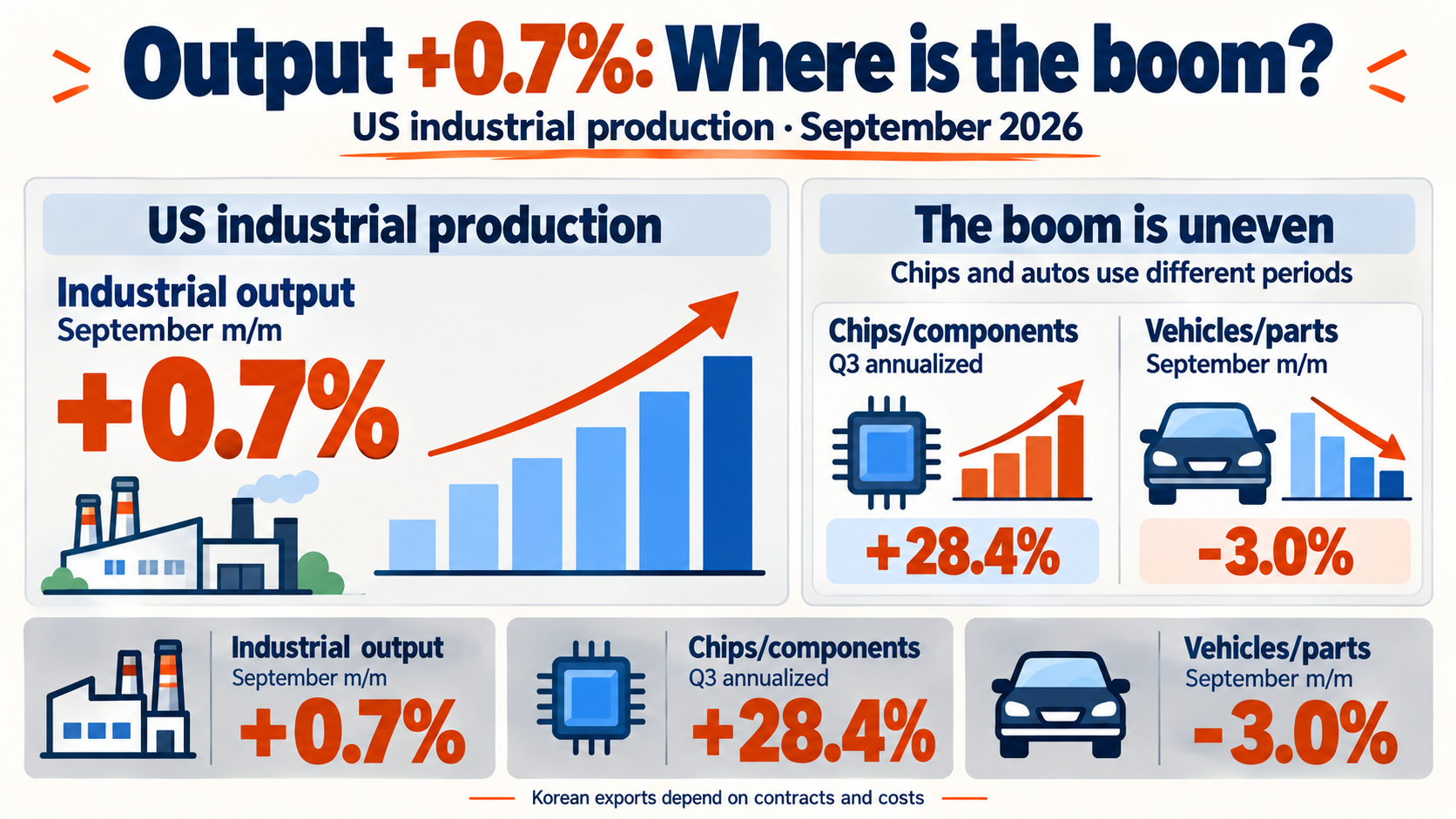
US industrial production rose 0.7% in September. Yet a chip boom does not establish a broad manufacturing recovery. For Korean suppliers, the useful question is which products are expanding and how much Korean content those products require. Source: Federal Reserve, 2026-10-16
The Fed’s October 16 G.17 release covers manufacturing, mining, and electric and gas utilities. It tracks real output rather than price inflation, and it is not a measure of the entire economy, including services.
First, put the chip and auto numbers on the right clocks
Semiconductor and related electronic-component output grew at a 28.4% annualized rate in Q3. Annualization expresses a quarterly pace as if it continued for a year; it does not mean output rose 28.4% in three months. The 3.0% decline in vehicles and parts compares September with August. Source: G.17 industry groups
Chips and components
+28.4%
Change
Period · Q3, annualized
Vehicles and parts
-3.0%
Change
Period · September, month on month
On the same monthly basis, manufacturing rose 0.3%, mining 0.2%, and utilities 3.5%. These growth rates are not contributions to aggregate growth: industry weights also matter. Source: G.17 summary
September output: a common monthly basis. Source: Fed G.17. Seasonally adjusted growth, not contributions.
Across Q3, industrial output grew at a 2.8% annualized rate, while manufacturing increased just 0.7%. Rapid chip growth coexisted with modest manufacturing gains. A single monthly rebound is insufficient evidence of a strong, broad uptrend. Source: G.17 quarterly results
Reuters linked the utility increase to demand for air conditioning. Weather-driven electricity output is different from new equipment orders. Metals, machinery, and electrical equipment also expanded in September; semiconductors were not the only growing industry. Source: Reuters, 2026-10-16
Why strong AI orders need not lift every factory
Expanding AI services requires processors, fast memory, servers, and power equipment. Orders concentrated along that chain can lift advanced components even when consumer-goods factories are quiet. This is an economic explanation, not a claim that G.17 isolates AI’s contribution.
Reuters identified AI infrastructure and inventory rebuilding as supports, with energy and borrowing costs posing risks. A company with committed orders may still expand capacity. One facing uncertain sales may defer investment when interest and electricity bills rise. Source: Reuters manufacturing analysis
-
1
AI investment
Orders for servers and parts
-
2
Supplier contracts
Qualification, share, delivery
-
3
Production
Volume × price − costs
-
4
Cash collection
Account for capex and interest
Higher output does not guarantee higher profit. Materials, power, and freight can absorb the extra revenue. Read alongside our earlier US producer-price analysis, the output release helps separate revenue growth driven by prices from growth driven by physical activity.
Utilization is 76.9%, so why does TSMC say supply is short?
Capacity utilization measures how much available production capacity is being used. Total utilization was 76.9%, below its 79.4% long-run average; manufacturing was 75.9%, against 78.2%. That does not suggest universal capacity pressure, but the average combines many factories that cannot substitute for one another. Source: Federal Reserve utilization tables
At TSMC’s October 15 earnings call, chairman and CEO C.C. Wei described AI demand as very strong and still above current supply capability. That need not contradict US average utilization: spare vehicle-production capacity cannot immediately make advanced chips. Source: TSMC earnings call, p. 15
On the same day, TSMC CFO Wendell Huang said leading-edge demand supported Q3 and was expected to continue into Q4. The first statement explains reported business; the second is management’s outlook. Neither is a forecast for all US output or for Korean memory suppliers. Source: TSMC earnings release, 2026-10-15
This Fed release is a statistical report, not interest-rate guidance. My interpretation is that concentrated investment demand and broader cost pressure can coexist. Output growth alone cannot establish overheating or justify a prediction of rate cuts.
What has to happen for Korean exporters to benefit?
For Korean chipmakers, the first question is whether US production creates memory orders. High-bandwidth memory, or HBM, stacks memory chips to move data rapidly. Growing AI server output helps a supplier only if its product qualifies and wins contracts. US output does not directly measure memory exported from Korea.
Equipment makers face another filter. Longer operating hours on existing tools can increase output without substantial new orders. A process upgrade or a new factory can create demand for tools and materials instead. Backlogs, actual customer spending, and payment collection show whether activity turns into cash.
For autos, the cause of lower US production matters. A supply disruption with stable demand may create an opening for Korean brands. Demand weakness and inventory reduction can instead pressure them to discount. Korean-owned US factories can also be part of the local production decline.
The September decline therefore does not establish a Korean market-share gain. US sales, dealer inventories, incentives, and factory schedules are necessary checks. If loan payments and living costs are postponing purchases, lower output may signal weaker demand rather than an opening left by rivals.
Fear in the US, greed in KOSPI: the gap between output and share prices
Investor appetite can move differently from factory output. CNN Fear & Greed stood at about 21.0 on October 23, extreme fear, down from 22.1 a week earlier and 32.5 a month earlier. GoldKimp’s KOSPI measure was 71.2, greed, on October 22. Different methods mean these are directional contrasts, not directly comparable scores. Source: CNN Fear & Greed Source: GoldKimp KOSPI
Comparable week-ago and month-ago KOSPI readings are not published, so we can't say how far sentiment has improved. SentimenTrader's public posts showed Smart Money at 0.50 and Dumb Money at 0.49 on October 15, both neutral. Those readings are more than a week old and say little about where institutions and retail investors are positioned now. Source: SentimenTrader Source: Public post mirror, 2026-10-15
AI output can rise while equity prices face pressure from delayed returns or higher funding costs. That continues the question raised in our AI financing and leverage discussion: an order that keeps a factory busy is not the same as cash ultimately available to shareholders.
The next checks are sustained chip orders, stable auto sales and inventories, and whether production growth improves margins. The Fed’s announced November 24 annual revision may also change historical output and utilization. Today’s numbers are a baseline for comparison, not a settled future. Source: G.17 revision notice
The useful signal for Korean companies is the difference between customers and products. Separating sales volume, contract prices, and production costs is more informative than assuming a broad boom. This is industry analysis, not a recommendation to trade a particular asset.
Sources and references
- Federal Reserve G.17, October 16, 2026
- Reuters, US manufacturing output rises in September, October 16, 2026
- TSMC Q3 2026 earnings release, October 15, 2026
- TSMC Q3 2026 earnings call, October 15, 2026
- CNN Fear & Greed, October 23 snapshot
- GoldKimp KOSPI Fear & Greed, October 22 snapshot
- SentimenTrader homepage
- SentimenTrader public post mirrored by TwStalker, October 15, 2026
For information only — this is not a recommendation to buy or sell any asset.
Comments 0