Commodity Outlook: World Bank Sees 23% Price Jump as Oil Stocks Drain
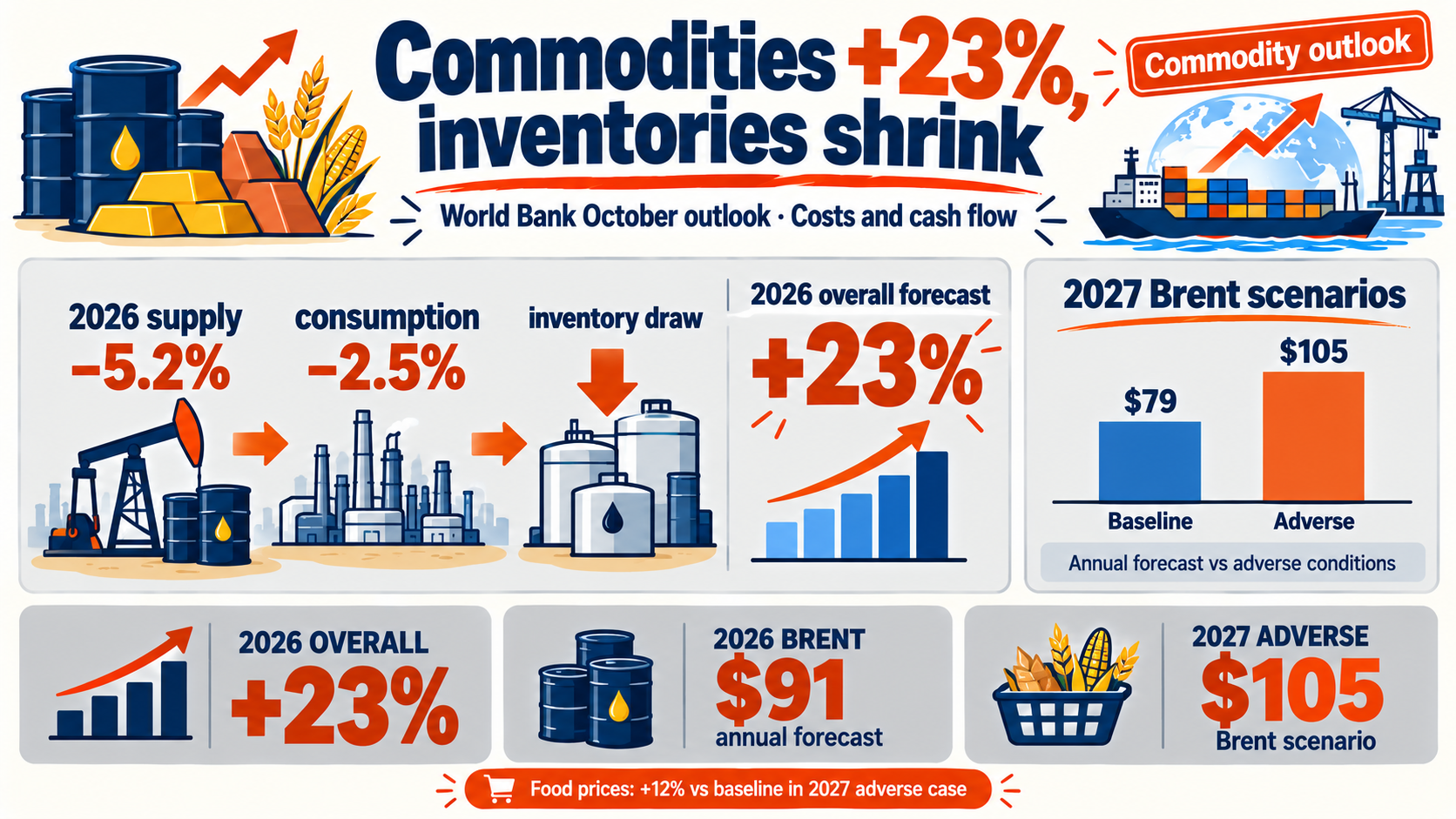
The World Bank’s October 28 commodity outlook projects a 23% rise in overall prices and a 32% rise in energy prices this year. For Korean readers, the useful question is how depleted inventories translate into company earnings and household budgets. Source: World Bank · 2026-10-28
Using less oil should help prices. But when production still falls short of consumption, even reduced demand requires withdrawals from storage. That inventory balance is the starting point for this article. This is analysis of industries and macro conditions, not a recommendation to buy or sell any security.
Commodity outlook: $91 Brent is an annual average, September averaged $116.8
The $91 Brent figure is a forecast for the 2026 annual average. The October 2 Pink Sheet records September Brent at $116.8 and Dubai crude at $93.3. Different averaging periods and crude grades cannot be substituted for one another. Source: World Bank Pink Sheet · 2026-10-02
An annual average below the latest monthly reading is not an offer to buy oil at that price tomorrow. Refiners must account for contract benchmarks, shipping time and freight. Food manufacturers likewise buy ingredients well before selling finished products.
Why falling consumption can still drain inventories
The Bank forecasts oil supply falling 5.2% and consumption falling 2.5% this year, with production below consumption and inventories still being drawn down. High prices restrain use, while electrification also reduces oil demand, particularly in China. Source: World Bank · 공급·소비 전망
Subtracting those growth rates does not establish a 2.7% oil shortage. Each rate uses its own previous-year base. Inventory changes depend on the difference between production and consumption volumes over the same period.
-
1
Production shortfall
Output below consumption
-
2
Stock withdrawals
Stored oil fills the gap
-
3
Greater sensitivity
Less room for another disruption
Inventories provide time to cope with shipping interruptions. With less spare stock, buyers have stronger incentives to secure cargoes quickly after a disruption. That does not establish a date when global tanks will be empty; the release provides no such countdown.
Our earlier discussion of OPEC+ targets and actual supply provides the background. An unchanged production target does not guarantee that buyers can receive crude when needed. The relevant follow-up is whether physical supply and inventories recover.
Food costs can outlast the oil shock
The 2027 Brent baseline is $79; an adverse scenario puts it at $105. The risks include intensified conflict, persistent damage to Russian oil infrastructure, disrupted Black Sea grain shipping and a very strong El Niño. El Niño changes tropical Pacific conditions and can affect regional rainfall and harvests. These are conditional annual averages, not guaranteed paths. Source: World Bank · 기준선·악화 시나리오
2027 Brent annual average: conditional forecasts. World Bank, October 28, 2026. $105 is an adverse scenario, not a probability forecast. · Axis starts at 67, not zero
Food prices are projected to rise about 10% this year and 7% next year. The adverse scenario’s 12% means above the 2027 baseline, not a 12% year-on-year rise. Source: World Bank · 식량 전망
Crop costs combine machinery fuel, fertilizer, yields and shipping. Cheaper fuel does not immediately reverse money already spent or repair a harvest. If reduced fertilizer use affects output, the consequences can last until a later crop cycle. This is why Korean food manufacturers’ input costs may turn later than oil prices.
Four industries, four different earnings channels
The following is our application to Korean industries, not a World Bank earnings forecast. The key is how quickly higher input costs can be passed through, and how many customers remain after that adjustment.
Refiners buy crude and sell fuels. Their profitability depends on product prices relative to input costs. Cheaper existing inventory can support earnings when oil rises, while replacing it requires more cash. A later price decline can turn expensive inventory into a burden.
Petrochemical producers turn feedstocks such as naphtha into plastics and other chemicals. Weak product demand can prevent them from passing through expensive feedstock. Margins may compress, less profitable plants may reduce output, and investment priorities may shift toward more efficient facilities.
Food companies face packaging and logistics bills as well as crop costs. Raising prices may protect margins per unit but encourage shoppers to switch to cheaper products. Customer willingness to accept an increase can matter as much as the original cost exposure.
Shipping outcomes depend on contracts. A fuel surcharge that passes costs to customers differs from a contract that leaves the carrier exposed. Higher freight rates during disruption do not guarantee higher profits when fuel, insurance and detour costs also rise.
Refining / chemicals
Product–feedstock margin
·
· · Separate inventory gains from cash needs
Food
Volumes after price increases
·
· · Check crops, packaging and freight
Shipping
Fuel pass-through clauses
·
· · Profit after fuel and other costs
Across all four industries, earnings and cash flow need to be read together. Revenue can rise while more cash is tied up in materials and inventory. Financing that working capital may require borrowing, leaving less room for investment and hiring after interest payments.
From Korea’s import bill to household purchasing power
For Korea, higher dollar prices raise the bill for an unchanged volume of imported energy and food. Other things equal, that weighs on the goods trade balance. Semiconductor and refined-product exports can offset it, so the commodity outlook alone cannot establish an overall trade deficit.
Won-denominated costs start with the dollar price multiplied by the exchange rate. In an illustration where the dollar price rises 10% and the won cost of a dollar rises 5%, the combined increase is 15.5%, not 15%. This is arithmetic, not an exchange-rate forecast.
Currency hedging reduces exchange-rate uncertainty. Locking an exchange rate does not also lock the dollar price of oil. A weaker won does not mechanically mean a higher hedging cost: maturity, interest-rate differentials, dollar funding conditions and transaction charges matter separately.
Passing costs through can transmit pressure from producer prices to consumers; failing to do so reduces corporate profits. Regulated utility tariffs and contract schedules create different delays. If wages lag living costs, households may cut discretionary purchases such as dining out and durable goods.
Why the World Bank and IMF put households before prices
On October 28, World Bank Deputy Chief Economist Ayhan Kose linked energy and trade disruptions to inflation, food insecurity and weaker growth, emphasizing protection for poor households. Applied to Korea, that means considering inflation control alongside support for households with limited incomes. Source: Ayhan Kose · World Bank
IMF Managing Director Kristalina Georgieva said on October 14 that the energy supply shock and AI demand were pulling growth in opposite directions. She also called for protecting people rather than prices as energy and food costs rise. Strong exporters do not automatically mean stronger purchasing power for every household. Source: Kristalina Georgieva · IMF · 2026-10-14
Broad price subsidies can ease bills immediately while increasing fiscal costs and weakening incentives to conserve energy. As discussed in our earlier article on energy support design, eligibility and duration matter. Central banks must also distinguish a temporary shock from broader price and inflation-expectation effects. This is policy analysis, not a report of a new Fed or Bank of Korea decision.
Equity sentiment differs across the two markets. The supplied October 28, 18:00 UTC CNN snapshot reads 34.5, or fear, up from 30.3 a week earlier and 32.4 a month earlier. GoldKimp’s October 27 KOSPI reading is 73.1, or greed. Different methods and missing Korean historical readings prevent a like-for-like trend comparison. Source: CNN · 제공 스냅샷 Source: GoldKimp · October 27
SentimenTrader’s public Smart Money and Dumb Money Confidence fields showed neither values nor an update date, so they are excluded from the inference. Optimistic Korean index sentiment is insufficient evidence of better earnings for cost-exposed industries; pass-through and cash flow remain the relevant checks. Source: SentimenTrader · 공개값 확인 불가
What would change the assessment?
The outlook improves if recovering physical supply rebuilds inventories, crop shipping and harvests stabilize, and companies need less cash to finance inputs. If oil falls because demand collapses instead, lower prices may coincide with weaker sales and economic activity. The cause of the decline matters.
The World Bank commodity portal lists November 3 as the next monthly data update. That can refresh price observations; company results can then be checked for inventory, volumes and operating cash flow. A price table alone cannot confirm an oil inventory recovery. The economic consequences ultimately show up in corporate cash and household purchasing power. Source: World Bank · 다음 데이터 갱신 예정
Sources and references
For information only — this is not a recommendation to buy or sell any asset.
Comments 0