Korea October exports hit $115.3bn: who keeps the profit?
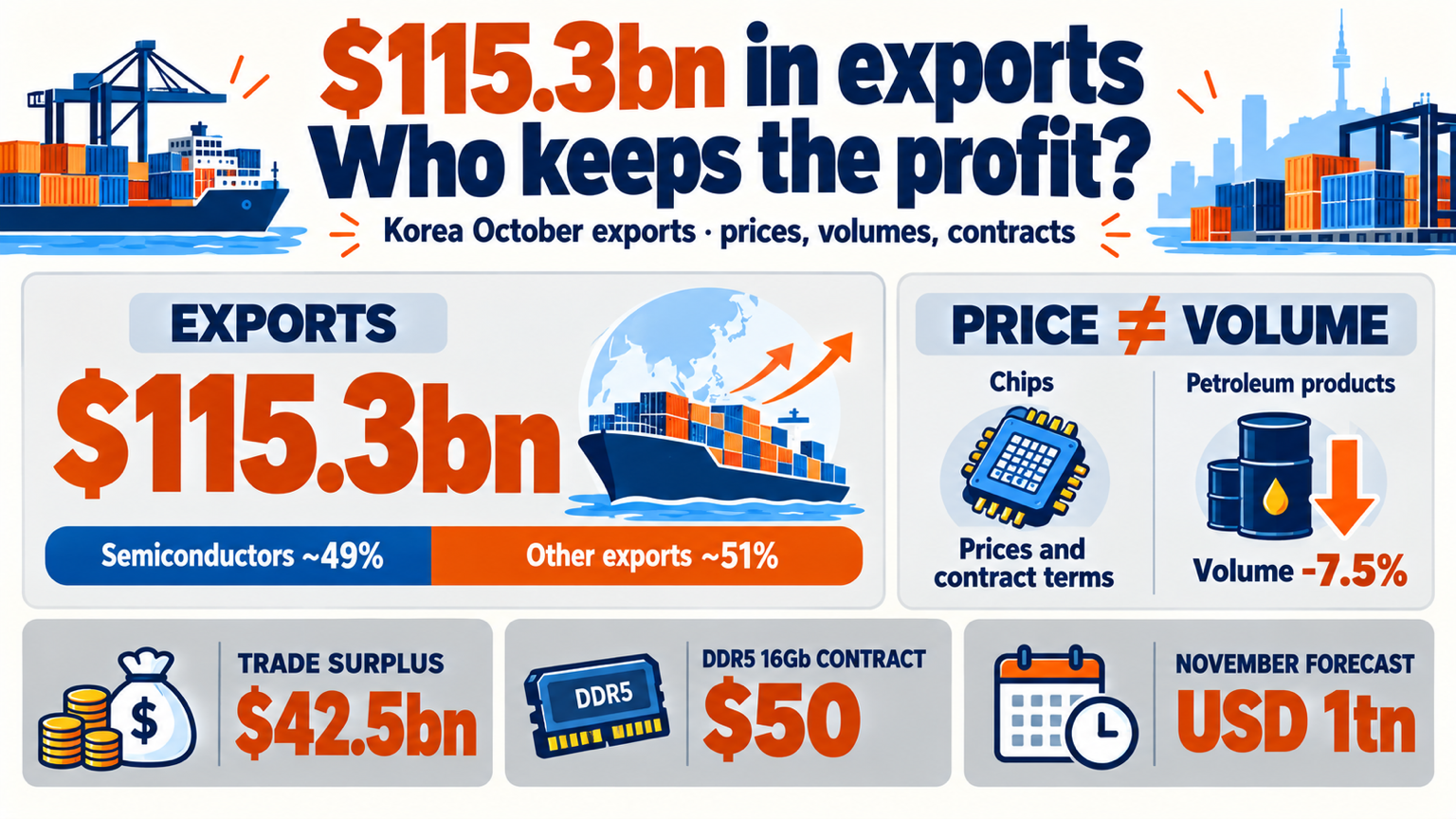
Korea October exports rose 93.7% from a year earlier to $115.3 billion. That does not mean factories made almost twice as many products, or that profits doubled. The useful question is how much of the increase came from volume, and how much from price. Source: 산업통상부 · 2026-11-01
Chips accounted for about 49% of the total, at $56.44 billion. Petroleum-product export revenue rose 80%, even as shipments fell. Both industries show impressive sales figures, but the implications for shareholders, workers and consumers differ. Source: 산업통상부 · 비중은 자체 계산
The figures below refer to provisional customs trade data for October 2026. Forecasts and conditional analysis are identified separately. This is economic analysis, not a recommendation to buy or sell an asset.
Read prices and quantities before celebrating the record
Customs data based on declaration acceptance show exports of $115.276 billion and imports of $72.775 billion. The difference, $42.501 billion, matches the ministry’s rounded surplus. Imports themselves grew 36%, so this is not a surplus generated by falling import spending. Source: 관세청 · 수리일 기준
October exports, imports and surplus. Korea Customs Service. Surplus calculated as exports less imports; bars are not additive.
The calendar helped. Chuseok moved from October last year to September this year, increasing working days in the comparison. Daily average exports rose 76%. That remains strong, but the headline 93.7% is not a productivity measure. Source: 산업통상부
October was the second-largest month on record, below September’s $121.1 billion. Daily exports also eased from $5.63 billion to $5.24 billion. One unadjusted monthly comparison cannot establish a downturn; equally, rapid annual growth does not prove growth is accelerating every month. Our September export analysis provides the industry background; the new question is how prices and contracts translate sales into earnings. Source: 산업통상부
A $50 DDR5 price is not a profit margin
Export revenue is broadly price multiplied by quantity. For chips, the product mix matters too: selling more advanced products can raise the average price even without increasing the number of units. The ministry attributes elevated semiconductor prices and volumes to AI capital spending. Source: 산업통상부
The ministry’s DDR5 16Gb contract-price series rose from $40 in June to $50 in October, about 4.2% above September’s $48. DDR5 is a memory standard used for temporary data storage in servers and PCs. This is a contract-price indicator for one specification, not the selling price of every exported chip. Source: 산업통상부 · 상승률 자체 계산
More servers require more memory. When supply cannot respond quickly, producers gain pricing room. Higher prices at well-utilized existing factories can lift profit faster than revenue. New capacity has a different cash profile: spending comes first, followed by depreciation—the allocation of equipment cost over its useful life. These are economic mechanisms, not earnings forecasts for a particular company.
Contracts are changing too. On October 28, SK hynix CEO Kwak Noh-Jung said customer trust was translating into long-term agreements that improve earnings stability and demand visibility. The company said agreements with 14 major customers cover more than half of its 2027–28 capacity, with mechanisms that reflect market conditions within agreed price ranges. Source: SK하이닉스 · 2026-10-28
The pricing clause matters as much as the contract’s duration. Long-term agreements support production planning but do not lock in every dollar of future profit. Actual deliveries, price adjustments and production costs determine the outcome. A single DDR5 price cannot reveal total semiconductor volume growth or company earnings.
Petroleum products earned more while shipping less
Petroleum products followed a different path: export prices increased 94.5%, while volumes fell 7.5%. Multiplying 1.945 by 0.925 gives about 1.80, consistent with roughly 80% revenue growth. Higher prices more than offset fewer shipments. Petrochemicals also combined rising prices with falling volume. Source: 산업통상부 · 곱셈 자체 계산
Memory supplier
Price, shipments and product mix
Revenue
Profit condition · Selling prices rise faster than costs
Check · Contract pricing and equipment spending
Refiner / processor
Higher prices can offset fewer shipments
Revenue
Profit condition · Product price less feedstock and transport
Check · Inventory funding, payment dates, price reversal
Refiners buy crude and sell processed products. Higher product prices can coexist with weaker earnings if feedstock and transport costs rise faster. The relevant variable is the spread between selling prices and costs. Crude import prices also rose 62%, according to the ministry. Subtracting the two growth rates would not produce a refining margin: contract timing, specifications and cost bases differ. Source: 산업통상부
Expensive inputs also require more money to finance inventory. A business can report rising export sales while cash is tied up in materials awaiting sale. If prices reverse, expensive inventory may lose value. The same price cycle creates different earnings risks on the way up and down.
Steel export revenue rose 22.3%, with the ministry identifying higher prices as a contributor. The release text reviewed here does not establish a decline in steel export volume. Price-supported revenue growth and a recovery in physical shipments are separate claims. Source: 산업통상부
China, the US and Europe imply different inventory and currency risks
Full-month exports were $26.98 billion to China, $24.90 billion to the US and $8.10 billion to the EU. Annual growth was 133.6%, 185.8% and 56.4%, respectively. The US grew fastest, but China remained the larger destination by value. Neither ranking tells us which market generated the most profit. Source: 산업통상부 · 10월 전체
October export growth by destination. MOTIR. Full-month export-value growth, not profit margins.
There is a timing trap in the regional breakdown. Product examples cover October 1–25, while regional totals cover the full month. The examples highlight chips in China; chips, computers and electrical equipment in the US; and cars, chips and machinery in the EU. Dividing these partial-month product figures by full-month totals would create misleading shares. Source: 산업통상부 · 지역별 품목 기간 주의
Chips cleared for China do not necessarily end up with Chinese consumers. They may be assembled into products exported elsewhere. Shipments to China therefore cannot be read solely as Chinese consumption. Factory inventories and demand from the ultimate customer both matter for repeat orders.
For US-bound AI equipment, delivery schedules and customers’ spending execution are important. Delayed acceptance or payment can leave suppliers carrying inventory and receivables despite strong orders. For European cars and machinery, purchasing budgets and distribution inventories deserve separate attention. These are risks to investigate, not observed regional margin estimates.
Currency hedging cannot be inferred from destination alone. A hedge can reduce earnings volatility by fixing an exchange rate for a future payment. European sales may be invoiced in dollars; dollar exporters may also pay dollars for equipment and materials. The relevant exposure depends on net receipts, payment dates and invoice currencies.
What the minister, the BOK and SK hynix say about spreading the boom
On November 1, Industry Minister Kim Jungkwan attributed export growth to AI demand and business competitiveness, and forecast annual exports would reach $1 trillion during November. He also highlighted difficulties faced by smaller and midsize firms from protectionism, supply-chain changes and Middle East instability. The government’s assessment itself distinguishes record totals from broad-based business conditions. Source: 산업통상부 · 장관 발언 의역
The Bank of Korea held its policy rate at 3.00% on October 22. It saw semiconductor exports and investment supporting growth, alongside inflation around 3% and remaining financial-stability risks. Strong exports do not automatically bring cheaper loans. Higher component and energy prices can raise exporters’ income while increasing living costs. Source: 한국은행 · 2026-10-22
SK hynix said it plans a substantial investment increase in 2027 while adjusting timing and scale to demand, profitability and investment efficiency. More factory, equipment and construction orders can spread income to domestic suppliers. The employment and consumption effect depends partly on imported equipment and automation. Source: SK하이닉스 · 투자 계획
Expectations may already be in share prices. CNN’s US Fear & Greed Index was 26.2, fear, on October 30: up 9.6 points over a week but down 4.1 over a month. GoldKimp’s Korean reading was 76.7, extreme greed, on October 29. The methodologies differ, and comparable Korean weekly and monthly readings were unavailable; the gap is not a precisely comparable measure of sentiment. Source: CNN · 10/30 snapshot Source: GoldKimp · 10/29 snapshot
SentimenTrader’s public-account headline for October 29 showed Smart Money at 0.57 and Dumb Money at 0.52, both neutral. Despite the names, these are not actual institutional and retail net purchases. Korean optimism alongside US caution is a reason to assess Korean export performance separately from the durability of American customers’ investment plans. Source: SentimenTrader 공개 계정 · 10/29
The connection runs through our analysis of Microsoft and Alphabet investment and cash flow. An order for a Korean supplier is an upfront cash commitment for its customer. A change in spending pace can affect the supplier’s next contract and inventory plan. One strong trade release cannot eliminate that risk.
Three things to watch beyond $1 trillion
Exports accepted by customs totaled about $930 billion through October, leaving roughly $70 billion to reach $1 trillion. Reaching it in November remains a forecast. The same customs page shows roughly $920.6 billion on a departure-date basis. Mixing the two measures would distort the milestone calculation. Source: 관세청 · 수리일/출항일 구분
The next releases should answer three questions. Do shipments hold up if price growth slows? Are export payments arriving on time, without inventory growing faster than sales? And do higher profits turn into orders, wages and jobs at domestic suppliers? In company accounts, receivables are sales not yet collected; inventories are materials and products not yet sold.
If prices and volumes remain resilient and customers pay promptly, exports can support investment and consumption more broadly. If high prices coexist with heavier inventory and debt burdens, record exports can coexist with a weak household economy. A trillion dollars would be a milestone; contracts, costs and cash collection will determine how widely—and how durably—it raises incomes.
Sources and references
- 산업통상부 2026년 10월 수출입 동향 (2026-11-01)
- 관세청 무역통계 — 10월 수리일 기준
- SK hynix 3Q26 results (2026-10-28)
- BOK decision and opening remarks (2026-10-22)
- CNN Fear & Greed — supplied 2026-10-30 snapshot
- GoldKimp KOSPI — supplied 2026-10-29 snapshot
- SentimenTrader — 공개 홈페이지
- SentimenTrader 공개 계정 미러 — 2026-10-29 headline
For information only — this is not a recommendation to buy or sell any asset.
Comments 0