Taiwan Exports Jump 58.9% in October: What a 34% US Share Means for Korean Chips
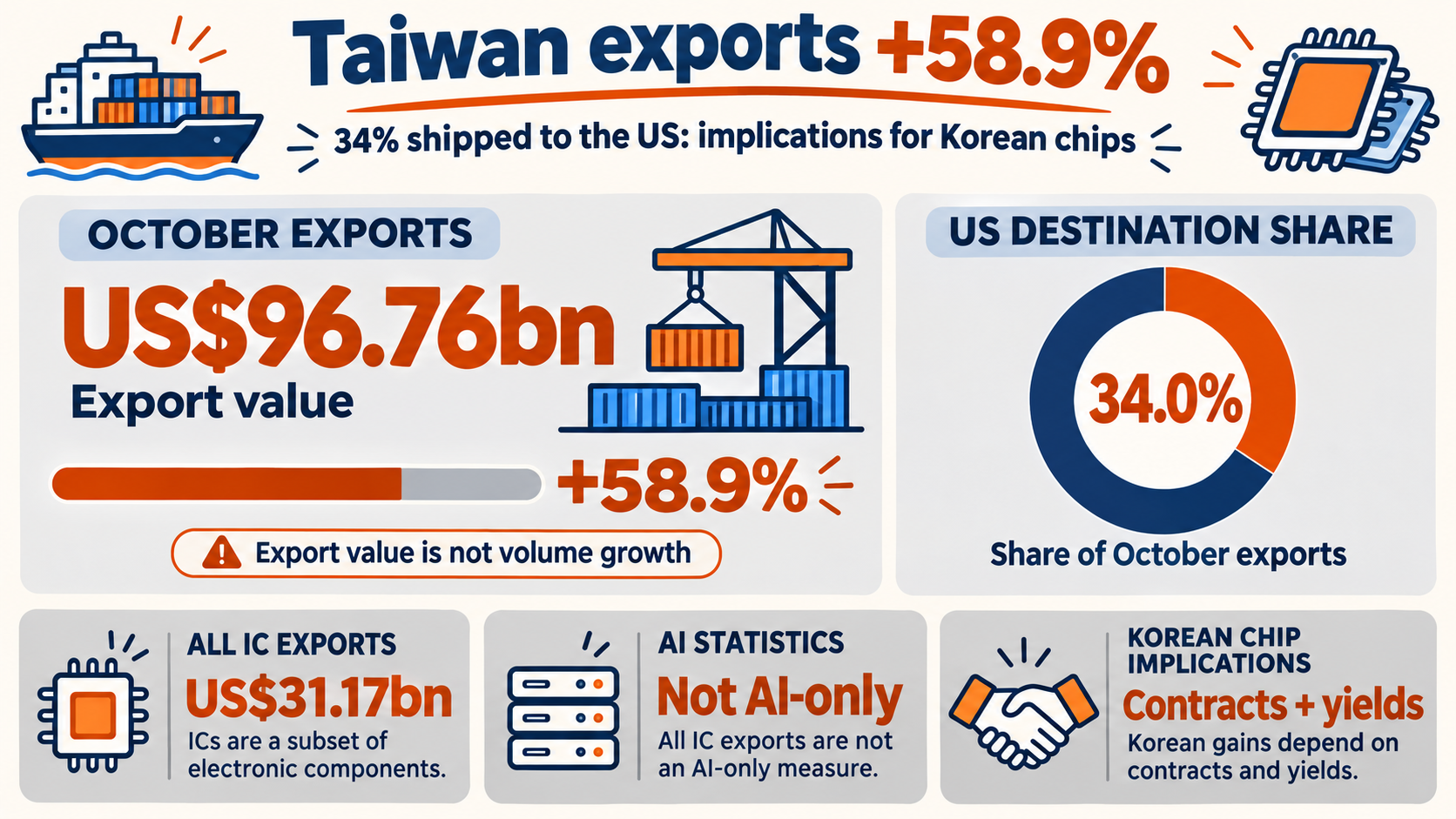
Taiwan exports reached a record $96.76 billion in October, up 58.9% from a year earlier. That is an encouraging demand signal for Korean semiconductor suppliers. To understand the earnings implications, however, we need to follow the orders through manufacturing and identify who actually captures the profit. Source: Taiwan MOF · 2026-11-09
The November 9 release reports preliminary customs trade values. Exports measure goods crossing the border. They differ from orders signed, corporate net income and value added within the economy. Those distinctions matter throughout this story.
Chips and servers dominate Taiwan exports
Information, communications and audiovisual exports reached $47.60 billion, while electronic components reached $32.68 billion. Both set monthly records. The two categories capture different parts of the chain: computers and related systems on one side, components on the other. Source: MOF · 품목별 통계
Integrated circuits, or ICs, generated $31.17 billion of exports, up 63.0%. ICs are a subset of electronic components, so adding the two would double count them. Nor does this customs category isolate AI chips. Strong AI demand does not make every exported IC an AI product. Source: CNA · IC 수출 세부 금액
October exports by category · US$100 million. MOF/CNA, Nov 9. ICs are included in components; do not sum all bars.
The ministry cited AI, high-performance computing and cloud demand alongside seasonal demand and rising prices. Export values can rise because more units ship, prices increase or the mix shifts toward expensive products. The 58.9% headline is therefore not a measure of production volume or wafer starts. Source: MOF · 증가 배경
Why AI investment reaches both foundries and packaging
An AI service provider needs additional servers to expand computing capacity. Designing the processor is only the beginning. A foundry manufactures the customer’s design on thin silicon wafers.
Manufactured processors must then connect to memory. Packaging provides those physical connections and assembles the components. High-bandwidth memory, or HBM, stacks memory chips to deliver data rapidly. Even when processors are available, shortages of memory or assembly capacity can delay complete servers.
-
1
Data-center investment
Secure servers and power
-
2
Foundry production
Build circuits on wafers
-
3
Memory and packaging
Connect and assemble chips
-
4
Acceptance
Deployment and collection
This creates opportunities for Korean suppliers. More AI processors produced in Taiwan can require more memory alongside them. Foundries and advanced packaging providers may also compete for the same customers and investment budgets. The implications depend on each company’s product and customer relationships.
What a 34% US share tells us about concentration
The United States accounted for 34.0% of October exports, ahead of China and Hong Kong at 21.1% and ASEAN at 19.1%. The US share rose from September’s 31.5%. But the prior October’s underlying figures imply roughly 34.7%, so the latest reading is not a year-on-year increase or an established record. Source: MOF · 표 8, 지역별 통계
October export destination shares · %. MOF Table 8. Selected destinations, not final-consumption shares.
Continued US data-center investment can benefit suppliers in both Taiwan and Korea. If customers delay equipment acceptance while reassessing returns, orders across both economies could weaken together. Owning suppliers in different countries does not necessarily diversify exposure to the same customer budgets.
A customs destination is not always the final user. Goods can undergo assembly elsewhere before reaching the United States, or move again after arriving there. The 34% figure describes direct export destinations, not the exact US final-demand exposure of Taiwan’s entire industry.
What Taiwan’s MOF and TSMC say about the limits of demand
On November 9, Beatrice Tsai, director-general of Taiwan’s MOF statistics department, linked changing export-market shares to supply-chain shifts amid US–China trade tensions and demand for AI technologies, according to CNA. Changes in production and procurement arrangements matter alongside end demand. Source: CNA · 차이메이나 발언
At TSMC’s October 15 earnings call, chairman and CEO C.C. Wei described AI demand as very strong. He also said capacity planning considers customer capital spending, data-center construction, finances, power and component availability. The company’s confidence is accompanied by checks on whether the infrastructure can actually operate. Source: TSMC · 2026-10-15
The economic implication is that willingness to invest and the ability to deploy infrastructure can diverge. Power delays or costly financing can stretch the time between orders and installation. Our earlier discussion of Microsoft and Alphabet’s AI investment and cash flow connects to this issue: suppliers need to monitor customer finances and equipment acceptance, not just spending announcements.
Market sentiment deserves a separate look. CNN’s Fear & Greed Index was 33.2, or Fear, on November 10: up 9.6 points over a week but down 10.3 over a month. GoldKimp’s KOSPI measure was 79.1, or Extreme Greed, on November 9. Their methodologies differ, so the score gap is not directly comparable. The contrast nevertheless makes it worth asking how much export optimism is already reflected in Korean share prices. Source: CNN · snapshot 2026-11-10 Source: GoldKimp · 2026-11-09
US CNN
33.2 · Fear (Nov 10)
Current
Week / month · +9.6pt / −10.3pt
Korea GoldKimp
79.1 · Extreme Greed (Nov 9)
Current
Trend · Comparable historical values unavailable
Comparable one-week and one-month KOSPI observations were unavailable, so no trend is inferred. SentimenTrader’s public page was checked on November 11, but Smart Money and Dumb Money Confidence values and their update date were blank. They cannot support a claim about a divergence in investor positioning. Source: SentimenTrader · 조회 시 수치 미표시
Where Korean suppliers can turn sales into earnings
Memory suppliers must meet performance requirements and qualify with customers. Yield—the share of production that becomes usable product—also matters. Poor yield can consume the benefit of high selling prices. Investors should examine costs and the opportunity cost of shifting capacity from existing products, alongside AI-memory revenue.
Equipment suppliers benefit from new factories and process upgrades. Taiwan imported $4.916 billion of semiconductor equipment in October, up 83.4%. That is not a measure of Korean equipment orders. Supplier selection, country of origin and customer acceptance determine which firms benefit and when revenue arrives. Source: MOF · 수입 구조, 4쪽
Chemicals and materials need the same selectivity. High-purity process materials require customer qualification and compatibility with the manufacturing process. Approved suppliers may benefit from higher wafer processing and utilization. These trade data do not establish an equivalent recovery in commodity petrochemicals.
Memory
Supply alongside AI processors
Opportunity
Check · Qualification, yield, costs
Equipment
Expansion and upgrades
Opportunity
Check · Vendor selection, acceptance
Materials
Qualified process materials
Opportunity
Check · Utilization, contracts, inputs
Exchange rates affect both sales and costs. Larger dollar receipts may be offset by dollar purchases of equipment and materials. Currency hedging reduces uncertainty, for example by fixing a future exchange rate. Exposure depends on net dollar receipts and payment timing, rather than gross exports alone.
The impact on household spending can take time. If firms reinvest earnings in factories and equipment, dividends and wages may not immediately rise. Broader hiring and supplier orders help spread the benefits. The distinction between revenue and profit in our analysis of Korea’s October exports applies here too.
November’s forecast is not a confirmed order book
The MOF’s November forecast was 47–51% year-on-year growth, or $94.2–96.7 billion, as reported by CNA and Reuters on November 9. It is a forecast, not a confirmed order book. Strong annual growth can coexist with a lower monthly export value because seasonality and the prior-year base affect comparisons. Source: Reuters · November outlook Source: CNA · 재정부 전망
October preliminary actuals
US$96.76bn
Exports
Year-on-year · +58.9%
MOF November forecast
US$94.2–96.7bn
Exports
Year-on-year · +47–51%
The next question is whether customer investment, actual component shipments and supplier margins improve together. Stable orders and better yields would support Korean earnings. Delayed acceptance, rising inventories and continuing expansion costs could instead weaken cash flow despite revenue growth. These are conditional scenarios, not outcomes already established by October’s figures.
Taiwan’s next trade release is scheduled for December 9 at 4 p.m. Taiwan time, or 5 p.m. in Korea. Checking its product and destination composition alongside the headline will help assess the durability of the expansion. This article explains economic mechanisms and is not a recommendation to buy or sell an asset. Source: MOF · 발표 일정
Sources and references
For information only — this is not a recommendation to buy or sell any asset.
Comments 0