Yuan Strength Meets a 6% FX Reserve Ratio: What Changes for Korean Firms
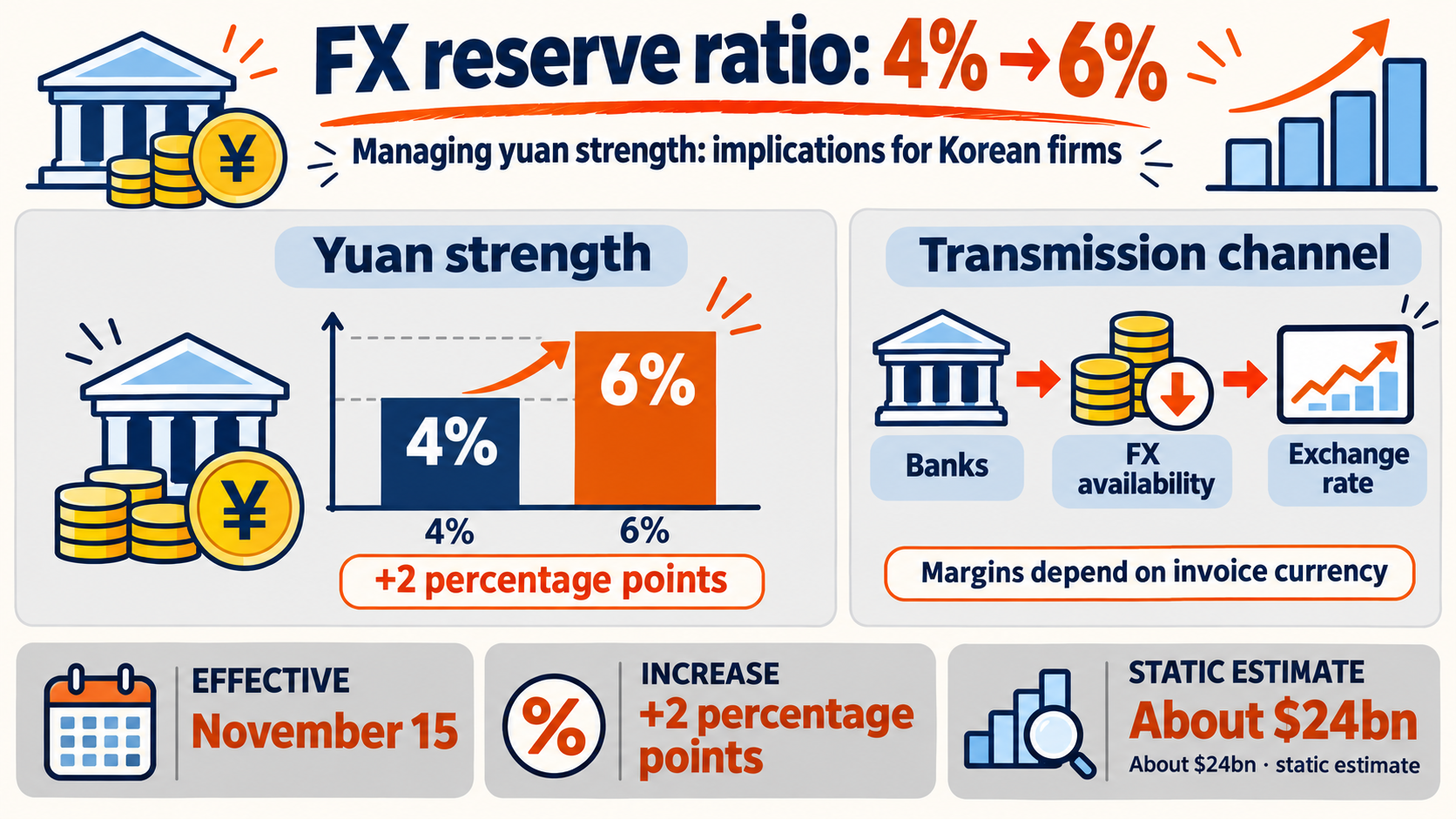
China is responding to yuan strength by adjusting foreign-currency liquidity. On November 3, the PBOC announced that the reserve requirement on foreign-currency deposits would rise from 4% to 6%, effective November 15. For Korean companies, the implications extend from Chinese customers’ purchasing power to export receipts and dollar funding conditions. Source: 신화통신 — 인민은행 공지 전재, 2026-11-03
The roughly $24 billion in news reports has not already left the market. It is an estimate of additional foreign currency banks may have to set aside, expressed in dollars. That distinction helps separate an attempt to moderate appreciation from a commitment to reverse the currency’s direction. Source: Reuters — 위안 강세와 외화 유동성, 2026-11-03
What a 6% foreign-currency reserve requirement changes
The foreign-currency reserve requirement is the share of foreign-currency deposits a bank must place with the central bank. In a simplified example with $100 of deposits, required reserves rise from $4 to $6. With everything else unchanged, less money remains available for lending or foreign-exchange transactions.
Required reserves as a share of FX deposits. PBOC notice, November 3, 2026. Increase: two percentage points.
This is separate from China’s sovereign foreign-exchange reserves and from reserve requirements on yuan deposits. The announcement alone does not mean the PBOC has raised its policy rate or ordered a broad tightening of yuan credit.
A republication of the PBOC’s end-September statistics puts foreign-currency deposits at about $1.2 trillion. Multiplying that rounded balance by the two-percentage-point increase gives $24 billion, the same scale as the Reuters estimate. Actual requirements depend on the eligible reserve base and deposits at implementation. The central bank did not announce a fixed withdrawal amount. Source: 인민은행 3분기 금융통계 전재 — 외화예금, 2026-10-14 Source: Reuters — 위안 강세와 외화 유동성, 2026-11-03
Nor should every unit of the affected deposits be assumed to be a US dollar. The precise interpretation is a reduction in available foreign currency, measured in dollar equivalents. Dollars do not disappear worldwide; the location and availability of foreign-currency balances inside China’s banking system change.
Why locking up more foreign currency can slow yuan strength
An exporter earning dollars may convert them into yuan to pay domestic wages and bills. That means selling dollars and buying yuan. Concentrated conversions increase dollar supply and yuan demand. Export receipts held in foreign currency do not create the same immediate pressure: the conversion decision matters.
A higher reserve requirement can offset part of that pressure by restricting banks’ usable foreign currency. Reduced supply and changing funding conditions may alter the price at which dollars are offered. It also signals official discomfort with rapid appreciation. Setting aside more foreign currency does not, however, automatically inject an equivalent amount of yuan.
-
1
More required reserves
Banks set aside a larger deposit share
-
2
Less usable FX
Lending and trading capacity adjusts
-
3
Supply and expectations
May moderate yuan appreciation pressure
Caixin described the decision as the first increase since late 2021, bringing this tool back into use after almost five years. But export receipts and companies’ conversion needs do not vanish. Adjusting liquidity cannot guarantee the exchange rate’s longer-term direction. Source: Caixin — 2021년 말 이후 첫 인상, 2026-11-03
Why the PBOC talks about pace, not direction
Reuters reported that PBOC Deputy Governor Zou Lan emphasized the market’s decisive role in exchange-rate formation at a Hong Kong forum on November 3. The bank’s October 8 policy position had also rejected a preset exchange-rate target and intervention in the long-term trend, according to Beijing Daily’s report the following day. The new requirement can be interpreted as a response to short-term one-way pressure within that framework. Source: Reuters — 쩌우란 부총재 발언, 2026-11-03 Source: 베이징일보 — 인민은행 10월 8일 환율 정책 설명, 2026-10-09
Marco Sun, chief financial market analyst at MUFG China, told Reuters the measure seeks to absorb some dollar liquidity and restrain appreciation momentum and one-way expectations. That is an analyst’s interpretation. The official notice cites foreign-currency liquidity management and specifies no desired exchange-rate level. Source: Reuters — 위안 강세와 외화 유동성, 2026-11-03 Source: 신화통신 — 인민은행 공지 전재, 2026-11-03
Domestic demand remains the broader issue. Paragraph 36 of the IMF’s China Article IV report, published on February 18, argues that exchange-rate flexibility can absorb external shocks and improve monetary transmission, alongside support for consumption and domestic demand. This predates the November decision. It explains why exchange-rate management alone cannot restore household demand and business orders. Source: IMF — 중국 2025 Article IV, 2026-02-18 공개, 문단 36
Our earlier discussion of China’s growth, property and domestic demand provides the underlying context. Lower exchange-rate volatility may make contracts and investment plans easier to price. Factory expansion still depends on final demand and capacity utilization. Managing foreign-currency liquidity is only one part of that picture.
For Korean businesses, start with the currency on the invoice
The following is conditional analysis, not an earnings forecast. A stronger yuan allows a Chinese buyer to purchase the same dollar-priced Korean component with fewer yuan. If the measure slows appreciation, that improvement in purchasing power may diminish. The benefit of an already stronger currency must be separated from the policy’s incremental effect.
A Korean exporter paid in yuan needs to watch the won value of each yuan. The same yuan revenue converts into more won when that cross-rate rises. But if the won strengthens alongside the yuan against the dollar, the benefit can shrink. The yuan-dollar rate alone cannot determine a Korean exporter’s currency gain.
Dollar receipts
Buyer’s yuan expenditure changes
·
· · Seller’s dollar revenue is unchanged
· · Dollar-won drives revenue translation
Yuan receipts
Yuan revenue is unchanged
·
· · Yuan-won drives revenue translation
· · Won appreciation can limit the gain
Consider a hypothetical $1 million component order. At seven yuan per dollar, the buyer pays 7 million yuan; at 6.7, it pays 6.7 million. The Korean supplier’s dollar revenue is unchanged. Whether the buyer spends its saving on additional orders or seeks lower invoice prices is a separate negotiation. These exchange rates are illustrative assumptions, not current quotes or forecasts.
Chinese companies face both sides of the adjustment. Yuan strength can lower the domestic cost of imported inputs and equipment while reducing the yuan received from dollar export sales. Import-heavy companies and exporters with predominantly domestic costs therefore respond differently. Slower appreciation can relieve margin pressure on the latter, potentially preserving their pricing competitiveness against Korean rivals in third-country markets.
Korean consumer goods and tourism also depend on the yuan-won rate. If the yuan outperforms the won, Korean shopping and travel may become relatively cheaper for Chinese consumers. Income, flight availability and willingness to spend must still support actual sales. Similarly, China’s yuan cost of commodities differs from Korea’s won import bill. Yuan appreciation alone determines neither world commodity prices nor Korean inflation.
As in our earlier analysis of exports versus corporate profits, price, volume and payment terms must be considered together. A lower local-currency bill for the customer does not automatically produce an equivalent profit gain for the supplier.
Why funding conditions and asset prices may diverge
Less usable foreign currency could worsen some firms’ dollar loan or conversion quotes. It does not follow that every Korean company’s hedging cost must rise. Currency hedging reduces exchange-rate uncertainty, for example by agreeing today on a rate for a future receipt. Its price reflects interest-rate differentials, maturity, bank funding conditions and credit terms.
Onshore yuan, or CNY, and offshore yuan, or CNH, also need to be distinguished. The rule directly affects foreign-currency deposits at onshore financial institutions. Expectations and transactions can transmit its effects offshore and to Korean banks, but an identical funding shortage does not arise automatically. Actual quotes by currency and maturity matter.
Equity risk appetite is divided. CNN's Fear & Greed Index read 19.4, or extreme fear, at 17:56 UTC on November 3, down 13.5 points over a week and 18.8 over a month. GoldKimp’s KOSPI reading for November 2 is 77.8, or extreme greed. No comparable Korean weekly or monthly values are available, so a rising trend cannot be established. The series also use different methods and dates. Source: CNN Fear & Greed — 2026-11-03 제공 스냅샷 Source: GoldKimp KOSPI Fear & Greed — 2026-11-02 제공 스냅샷
SentimenTrader’s public page does not show current Smart Money or Dumb Money Confidence values or dates, so no positioning conclusion is drawn from them. US fear and Korean greed do not directly measure dollar supply inside China either. The divergence is a reason to examine foreign capital flows and company margins separately, rather than label the reserve move uniformly positive or negative for Korean stocks. Source: SentimenTrader — 공개 페이지 수치·날짜 미표시 확인
After November 15, watch contracts more than exchange rates
After implementation, watch bank funding terms and companies’ conversion behavior. If appreciation merely slows while trade-finance conditions remain stable, exporters may gain time to adjust pricing. If foreign-currency lending or payment terms deteriorate, inventory and order-fulfillment costs may rise. These are possible transmission channels, not observed outcomes.
For Korean companies and investors, three checks are useful: actual orders from China; movements in both yuan-won and dollar-won rates; and pricing and payment periods in new contracts. Share prices may react immediately while earnings effects arrive later, when receipts are converted or contracts renewed.
The measure reduces banks’ discretion over usable foreign currency and may moderate one-way exchange-rate pressure. Its Korean effects emerge through the next steps: who buys the product, how it is priced and which currency settles the invoice. The sector implications here are conditional analysis, not recommendations to trade particular assets.
Sources and references
- 중국 정부·신화통신 — 11월 3일 외화 지급준비율 발표
- 신화통신 — 인민은행 공지 전재, 2026-11-03
- Reuters — 위안 강세와 외화 유동성, 2026-11-03
- Reuters — 쩌우란 부총재 발언, 2026-11-03
- 인민은행 3분기 금융통계 전재 — 외화예금, 2026-10-14
- Caixin — 2021년 말 이후 첫 인상, 2026-11-03
- 베이징일보 — 인민은행 10월 8일 환율 정책 설명, 2026-10-09
- IMF — 중국 2025 Article IV, 2026-02-18 공개, 문단 36
- CNN Fear & Greed — 2026-11-03 제공 스냅샷
- GoldKimp KOSPI Fear & Greed — 2026-11-02 제공 스냅샷
- SentimenTrader — 공개 페이지 수치·날짜 미표시 확인
For information only — this is not a recommendation to buy or sell any asset.
Comments 0