Blood-brain barrier APOA1 import falls in early Alzheimer’s mice: Yang’s 92-protein map and dementia care costs
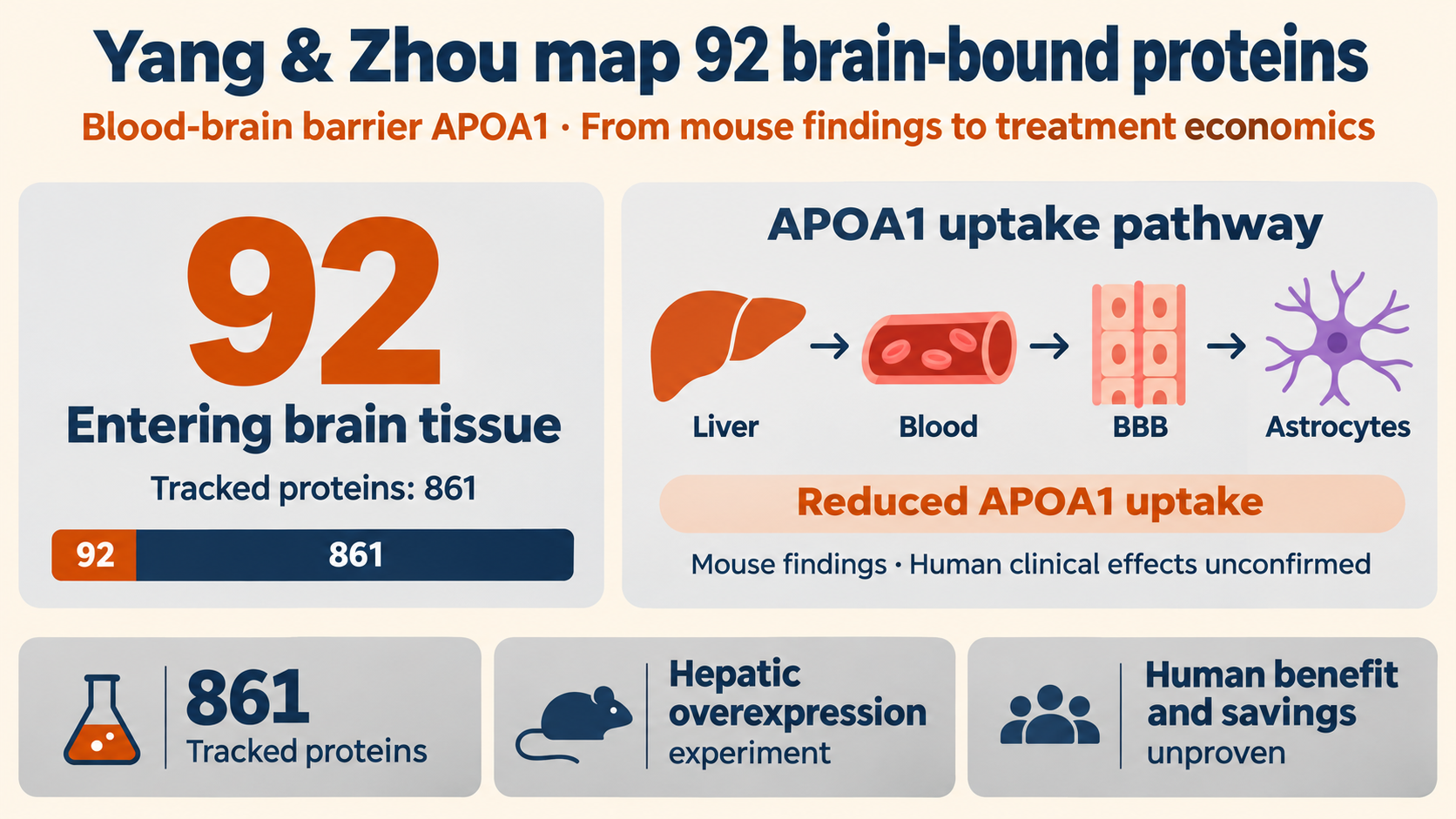
Andrew Yang and Haoyue Zhou at Gladstone Institutes have mapped 92 blood proteins that enter mouse brain tissue. Their November 11 Cell study suggests that early Alzheimer’s-like disease can involve a loss of useful protein supply, before widespread barrier leakage. The APOA1 findings raise a practical question: could treatment from outside the brain eventually improve both care and its economics? This is a research explainer, not a recommendation to buy or sell any company’s shares. Source: Gladstone
Why Andrew Yang set out to map blood proteins
Yang’s earlier work examined how physiological blood-to-brain transport changes with ageing. A 2020 Nature paper provides that background. The new study takes the question down to particular proteins and their recipient cells. Source: Yang et al., Nature 2020
First author Zhou is a postdoctoral researcher in Yang’s laboratory. Co-authors include Gladstone’s Alexander Pennacchio and UCSF’s Jason Maynard. Their starting question concerns the proteins that a healthy brain normally receives, providing a biological basis for thinking about future interventions. Source: Gladstone 연구진 소개
What the 92-protein map actually measures
The blood-brain barrier is the cellular interface controlling exchange at brain vessels. Zhou and colleagues labelled plasma proteins and followed them after injection into mice. Bioorthogonal chemistry provides labels designed to minimise interference with biological reactions. Source: Gladstone 방법 설명
There were 861 tracked protein species. The authors distinguish 191 sampled by the barrier from 92 entering the brain parenchyma, the tissue beyond the vessels. These are counts of protein species, not percentages of an injected dose reaching the brain. Source: Cell 초록·JoVE 재현본
Sources: Gladstone and Cell abstract. Counts are not additive or dose-delivery percentages.
The distinction matters in development: a signal associated with brain tissue does not by itself establish delivery to the intended cells. The atlas offers candidates for investigation. It is not a list of 92 individually validated neuroprotective treatments.
How APOA1 connects to astrocytes
Yang and Zhou examined APOA1, a circulating protein involved in lipid transport. Their abstract distinguishes passage across the barrier via SR-B1 from action involving ABCA1 in astrocytes. Astrocytes support the neuronal environment; ABCA1 helps move cholesterol out of cells. Source: Cell 초록
The proposed sequence links astrocytic cholesterol efflux to maintenance of synapses, the connections between neurons. Raising a blood concentration is therefore only part of the problem: transport and the receiving cell’s response must both work. Source: Cell 초록
-
1
Liver and blood
APOA1 supply
-
2
Blood-brain barrier
SR-B1-mediated passage
-
3
Astrocytes
ABCA1 and cholesterol efflux
-
4
Synapses
Maintenance of neuronal connections
Early-stage 5xFAD mice showed less APOA1 uptake but more SERPINA1 uptake. This is a genetically engineered Alzheimer’s model. Increasing hepatic APOA1 expression restored brain APOA1 and improved reported astrocytic, synaptic and behavioural outcomes. It does not establish universal transport failure or restored human memory. Source: Cell 초록
Leakage remains relevant. The study adds an earlier, selective transport disturbance in a model. This article relies on the accessible abstract and institutional reporting; full-text effect sizes and supplementary protocols could not be independently checked. The evidence should not be described as a cure or complete recovery of memory. Source: Nature 연구 보도
What treatment from outside the brain could change
There are distinct development possibilities: increase production in the liver, or administer a manufactured protein medicine. Yang’s evidence concerns hepatic overexpression in mice. It does not demonstrate equivalent efficacy from dosing a recombinant APOA1 product.
The following is an industrial inference. Effective liver-directed treatment might reduce some direct brain-delivery demands. Liver-targeted approaches are already being tested in other diseases, as our earlier piece on liver-targeted base editing described. Persistent expression, however, creates questions about controllability and systemic safety. Protein dosing may be easier to adjust but retains repeat administration, purification and quality-control costs. A familiar manufacturing process does not guarantee an inexpensive medicine.
Increase liver production
Sustained endogenous supply
Potential
Required evidence · Expression control and systemic safety
Protein medicine
Adjustable dosing
Potential
Required evidence · Repeat dosing, manufacturing and brain delivery
Industry already treats barrier transport as a development problem. On November 10, Roche announced enrolment in the phase III PrevenTRON study of its Brainshuttle antibody trontinemab, alongside plans for CTAD on November 16–19. This is evidence of clinical investment in delivery, not validation of APOA1 therapy. Scheduled presentations are not completed results. Source: Roche 2026.11.10
The atlas could help narrow delivery candidates and improve early experimental productivity. But attaching an antibody or gene-therapy cargo may change transport. Antibody-drug conjugates also require separate targeting and toxicity validation. A nearer prospect is additional delivery platforms and combination candidates, rather than immediate replacement of existing antibodies.
The economic test extends beyond the drug price
Translating Yang’s findings into savings requires looking at real treatment resources. Existing antibody therapy includes safety monitoring: FDA recommended an additional MRI before the third Leqembi infusion to detect relevant brain abnormalities earlier. It is unknown whether an APOA1 approach would need less monitoring. Source: FDA 안전성 공지
Korean costs extend well beyond medicines. The 2023 dementia survey released by the health ministry in 2025 reported annual management costs of KRW 17.339 million for community residents and KRW 31.382 million for hospital or facility residents. These include healthcare and care-related costs. They are not 2026 drug prices or Alzheimer’s-only treatment costs. Source: 보건복지부 치매실태조사
MOHW release, 2025. Includes more than drug costs; the group difference is not a treatment saving.
Subtracting these group averages does not estimate a new drug’s savings. Disease severity and living circumstances differ. The relevant question is whether treatment preserves daily function and actually reduces care hours or institutional use. Less family caregiving could free time for paid work, but that benefit must be measured.
Payers would need to compare added drug, administration, testing and adverse-event costs with measured reductions in healthcare and care use. Even an effective therapy can increase the total budget if many more people receive it for longer. Cost-effectiveness and budget savings are different outcomes.
The next test: does restored transport predict better lives?
For Yang and Zhou’s findings to improve clinical-development efficiency, a transport defect must first be measured reproducibly in people. Increased blood APOA1, increased brain delivery and improved cognitive or daily function are separate outcomes. One blood test cannot be assumed to represent all three.
A surrogate endpoint is a measure used to predict a clinical outcome. Restored import could serve that role only after showing that treatment-induced changes reliably predict meaningful patient benefit. Correlation alone is insufficient. At present it is a research question, not an established substitute for clinical outcomes or coverage evidence.
Our earlier article on Alzheimer’s genetics discussed the search for disease-related targets. This study asks which circulating proteins actually reach which brain cells. Combining such approaches may eventually improve patient selection and treatment design. Related: 관련 글: 알츠하이머 유전체 연구
The most valuable change is a broader set of places to intervene. Starting in the liver does not automatically make treatment simple or cheap. The industrial value becomes concrete when the biological route is connected to preserved human function and reduced care burden.
The economic case requires evidence connecting brain delivery to daily function and care needs.
Sources and further reading
- Zhou et al., Cell (2026), DOI: 10.1016/j.cell.2026.10.039
- Cell abstract reproduced by JoVE Visualize
- Gladstone — Study Rewrites the Rules of the Blood-Brain Barrier
- Nature — New culprit in early Alzheimer’s
- Yang et al., Nature (2020) — Physiological blood–brain transport
- Roche CTAD 2026 announcement, 10 November 2026
- FDA — Additional earlier MRI monitoring for Leqembi
- 보건복지부 — 2023년 치매역학조사 및 실태조사 결과 발표 (2025.03.12)
For information only — this is not a recommendation to buy or sell any asset.
Comments 0