Huntington Disease Spatial Transcriptomics: Cleveland’s 428,000-Cell Map and Drug Development Costs
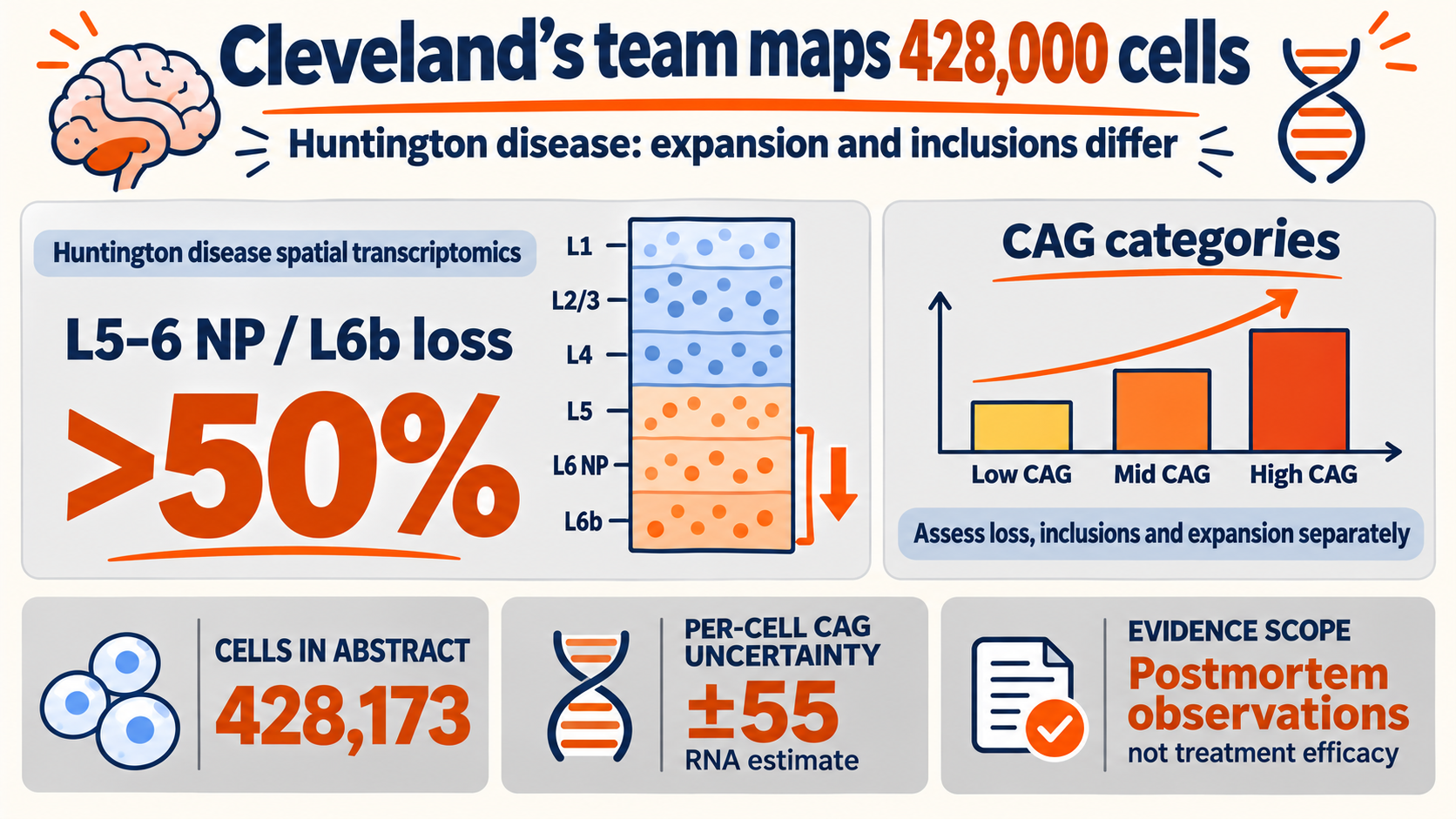
Don W. Cleveland’s team at the University of California San Diego examined roughly 428,000 cortical cells in a Huntington disease spatial transcriptomics study. Certain deep-layer neurons were reduced by more than half relative to controls, but their vulnerability did not simply track the conditions with the most protein inclusions. Published online in Cell on October 28, 2026, the work raises a practical question: what should drug developers measure before committing to expensive trials? Source: Cell 연구
Huntington disease is an inherited neurodegenerative condition affecting movement, thinking and everyday function. Knowing the causal gene does not make treatment straightforward. A better average measurement across a sample does not necessarily tell us whether the cells that matter have been protected. Source: uniQure 질환·개발 설명
Cleveland’s UC San Diego team: who did what
Cleveland has worked on RNA-targeted strategies for neurodegenerative disease, including research targeting abnormal C9orf72 RNA in ALS and frontotemporal degeneration. He is the lead contact for this paper and contributed to its design, interpretation and writing. Source: UCSD 연구자 소개 Source: Cell 저자 기여
First-listed author Sonia Vazquez-Sanchez, Olatz Arnold-Garcia and Carlos Chillon-Marinas designed the study, performed experiments and analyzed data. Bogdan Bintu also contributed to design, interpretation and writing. The collaboration connects disease biology with methods for reading molecules inside intact tissue. Source: Cell 저자 기여
The paper discloses that Cleveland is a consultant for Ionis Pharmaceuticals. That relationship is relevant context for an RNA-related study; the experimental findings and expectations for therapies still need to be assessed separately. Source: Cell 이해관계
What spatial transcriptomics reads in the same cell
The starting point is a repeated three-letter DNA sequence, CAG, in the HTT gene. Repeats can lengthen further in some cells during life, a process called somatic repeat expansion. The inherited repeat length and the expanded length inside a particular brain cell are different measurements. Source: Cell 배경·측정법
MERFISH uses fluorescent probes and repeated imaging to read RNA molecules. Spatial transcriptomics preserves their location in tissue. The team added measurements of huntingtin protein inclusions and estimates of repeat length, linking cellular identity, position and molecular state. Source: Cell 방법
Single-nucleus RNA analysis offers broad gene-expression measurements, but isolated nuclei do not retain all their original spatial and protein context. The new approach strengthens those connections. This is a complementary advantage, not evidence that imaging measures repeat length more precisely than sequencing. Source: Cell Discussion
Isolated-nucleus analysis
Broad RNA profiling
Strength
Missing context · Spatial and protein context are harder to retain
Multimodal MERFISH
Links location, RNA and pathology
Added value
Trade-off · Targeted panel; RNA-based CAG estimates
Two headline numbers need to stay separate. The large cell-type analysis used a 188-gene panel. The more detailed 1,128-gene analysis used tissue from five HD donors and four controls. It would overstate the study to say that all roughly 428,000 cells had every gene and pathology readout measured. Source: Dryad 패널별 자료 Source: Cell Results
MM-188: 6 controls, 8 HD. MM-1128: 4 controls, 5 HD. Overlapping cohorts; do not sum. Dryad README.
There is also a documentation discrepancy: the abstract reports 428,173 cells, while the repository describes 428,973 in the 188-gene dataset. The reason for the 800-cell difference is unverified. This article uses the abstract’s rounded figure and does not add counts across overlapping analyses. Source: Cell 초록 Source: Dryad README
Deep-layer neurons fell by half, but inclusions told a different story
The particularly vulnerable populations were L5–6 near-projecting neurons and L6b excitatory neurons in deep cortical layers. Near-projecting identifies a neuronal class; excitatory neurons promote activity in other neurons. A loss exceeding 50% in these populations does not mean that half of all cortical cells disappeared. Source: Cell Summary
The analysis linked selective vulnerability to very large expansions, especially the estimated range above 450 repeats. Nuclear HTT inclusions were most prevalent around 250–350 repeats and associated with broader transcriptional changes. Counting inclusions alone therefore cannot provide a simple ranking of cellular vulnerability. Source: Cell Results
Deep-layer neuron loss
L5–6 NP and L6b
Population
Loss · >50% in these types
Associated range · Very large expansion: >450 CAG
Nuclear HTT inclusions
Intermediate: 250–350 CAG
Most prevalent
Association · Broader transcriptional changes
Interpretation · Not interchangeable with loss
This does not establish that inclusions are harmless or that blocking repeat expansion alone will cure HD. The team studied postmortem tissue. Cells already lost cannot be measured directly, and a snapshot of surviving cells cannot establish the sequence of events. Separating signals is not the same as proving causation. Source: Cell Limitations
Repeat lengths were inferred from HTT RNA fluorescence, with uncertainty of ±55 repeats per cell, and only transcribing cells could be profiled. The 450-repeat figure is not a clinical treatment threshold. Targeted gene coverage and the limited donor sample further support the need for independent repeat measurements and replication. Source: Cell Limitations
The economic question is the cost of a wrong decision
The first economic implication of Cleveland’s work concerns candidate selection rather than drug pricing. Antisense oligonucleotides are short nucleic-acid drugs designed to bind RNA; RNA interference uses small RNAs to reduce protein production. For either approach, connecting target reduction with protection of vulnerable cells could strengthen decisions about further development.
Roche’s July 9, 2026 community letter reported reduced mutant HTT and the neuronal-injury marker NfL in GENERATION HD2, but no meaningful clinical efficacy impact; the tominersen trial was discontinued. The Cell study does not explain that outcome. The trial does illustrate why biomarker changes and patient function require separate validation. Source: Roche 서한 원문 재게시
Other programs are moving forward. On November 2, uniQure announced acceptance of the AMT-130 application for US Priority Review, with a target action date of May 1, 2027. Acceptance is not approval. The candidate uses an AAV vector to deliver a gene encoding a small RNA that reduces HTT production and requires neurosurgical administration. Source: uniQure 11월 2일 발표 Source: AMT-130 투여 방식
The following cost argument is analysis, not a measured result of the paper. Adding spatial profiling to preclinical comparisons may raise the cost of each experiment. It could still reduce total development spending if it identifies poorly targeted candidates earlier or avoids repeated experiments caused by misinterpreting where a drug acts. If it merely reproduces existing answers, it becomes an additional expense.
-
1
Added spending
Spatial assays and independent validation
-
2
Better decisions
Check delivery and protection in vulnerable cells
-
3
Conditional benefit
Avoid uninformative follow-up and poor trial candidates
The decision rule is straightforward: avoided downstream research costs must exceed the added measurement and validation costs. Neither the savings nor a change in success probability was measured here. The work motivates separate evaluation of inclusions, expansion and cell protection; it does not prove combination therapy superior or single-target treatment ineffective.
This connects with our earlier discussion of RNA fingerprinting and candidate selection. If a gene therapy reaches practice, administration and safety follow-up remain costs alongside manufacturing, as the HG302 early clinical study also illustrates. Related: RNA fingerprinting Related: HG302 초기 임상
For Korea, the opportunity comes after buying equipment
The team’s research method is not automatically a hospital diagnostic product. Repeated cortical sampling is not a routine way to monitor living patients. More plausible early uses are comparisons of donated tissue and experimental models, and research linking accessible fluid biomarkers to tissue changes.
Platform competition already has a contractual dimension. Vizgen announced a litigation settlement with 10x Genomics and Harvard in April 2025. Separately, 10x announced a Bruker settlement in May under which Bruker would pay $68 million plus ongoing royalties. These are not prices for the Cell method; they show that intellectual property has tangible commercial consequences in spatial biology. Source: Vizgen 공식 발표 Source: 10x 공식 발표
The outlook for Korean institutions and companies is conditional. Purchasing equipment alone does not create a competitive service. They would need to validate robustness to tissue quality, accuracy of cell segmentation and agreement with independent repeat measurements. A contract research organization that turns those checks into reproducible services could build a new revenue stream.
Conversely, low sample throughput combined with imported instruments and proprietary reagents could leave per-sample costs high. Shared facilities, analysis software and reference-sample quality control are therefore worth evaluating. This research did not verify a Korean import or CRO-spending time series, so it does not assign a domestic growth rate or market size.
For patients and families, the largest economic benefit would arise if treatment genuinely preserves everyday function, potentially reducing care time and pressure to leave work. Treatment, administration and follow-up costs would have to be counted as well. A postmortem tissue map cannot quantify that benefit.
Cleveland and colleagues make the question of what changes in the brain more specific. Research funders can ask a more specific question too: will these measurements improve the choice of candidates advancing to the next stage? That decision value will determine whether the added analytical capability earns its cost. This article is not investment advice on any company or therapy mentioned, and treatment decisions belong with clinicians.
The economic value of spatial profiling depends on better candidate decisions and patient benefit.
Sources and further reading
- Vazquez-Sanchez et al., Cell (2026): Multimodal spatial transcriptomics redefines cortical pathology in Huntington’s disease
- Dryad: Multimodal MERFISH data and README
- UC San Diego: Don Cleveland profile and publications
- Roche community letter: GENERATION HD2 and POINT-HD discontinuation (IHA reproduction)
- uniQure: AMT-130 BLA acceptance and Priority Review
- uniQure: AMT-130 clinical trial mechanism
- Vizgen: End of litigation with 10x Genomics and Harvard
- 10x Genomics: Patent settlement with Bruker
For information only — this is not a recommendation to buy or sell any asset.
Comments 0