ANGPTL3 base editing: Khera’s team reports three-year primate durability—could care costs change?
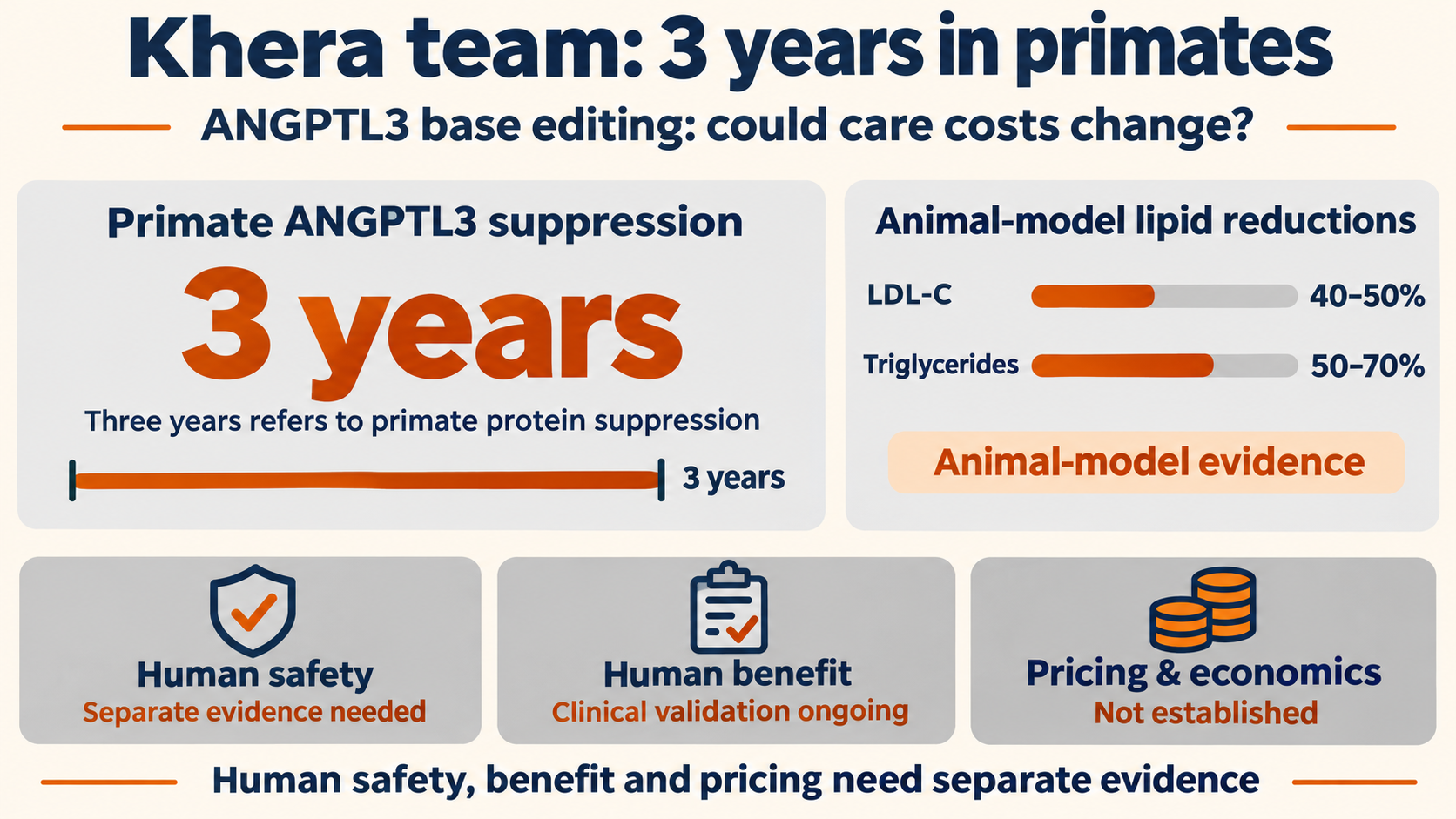
Amit V. Khera, Taiji Mizoguchi and colleagues at Verve Therapeutics published an ANGPTL3 base-editing study in Nature on November 6. Target-protein suppression persisted for three years after a single dose in nonhuman primates. Durable effects in patients could reduce repeat treatment, but lower total costs would require a separate economic case. Source: Nature: In Vivo CRISPR Base Editing of ANGPTL3 for Durable Lipid Lowering
Replacing daily medication with one infusion sounds convenient. But fewer doses, fewer clinic visits and fewer heart attacks are three different outcomes. Keeping them apart is the whole trick to reading this study.
Khera and Mizoguchi: the people behind the work
Khera is the corresponding author, and Mizoguchi is the first listed author. Verve researchers Jamie E. DeNizio and Alexandra C. Chadwick are among the coauthors, alongside Kiran Musunuru at the University of Pennsylvania. The available author information does not establish individual experimental assignments. Source: Nature: In Vivo CRISPR Base Editing of ANGPTL3 for Durable Lipid Lowering
Khera and Musunuru also coauthored a 2017 JACC study of ANGPTL3 deficiency and coronary artery disease. That work connects naturally occurring genetic variation with a possible treatment target. Lifelong inherited variation, however, cannot guarantee the outcome of editing liver cells later in life. Source: Stitziel et al., JACC 2017: ANGPTL3 Deficiency and Protection Against Coronary Artery Disease
The challenge: what if LDL receptors work poorly?
LDL particles carry cholesterol through the blood; LDL-C measures their cholesterol content. Liver LDL receptors help remove those particles. Statins and PCSK9 inhibitors depend on receptor function for their effects. Responses can therefore be limited in homozygous familial hypercholesterolemia, or HoFH, where inherited defects severely impair that function. Source: DailyMed: EVKEEZA prescribing information
ANGPTL3 restrains enzymes involved in lipid processing. Blocking it can lower triglycerides and LDL-C through mechanisms that do not require functioning LDL receptors. The approved antibody evinacumab, marketed as Evkeeza, already uses this target. The team’s distinctive proposition is durable suppression of protein production in the liver, rather than the discovery of an entirely new target. Source: DailyMed: EVKEEZA prescribing information
Delivery presents a second receptor problem. Verve explains that conventional lipid nanoparticles can struggle to deliver editors when liver LDL receptors are deficient. GalNAc is a sugar-based ligand added to the particle to engage another liver receptor, ASGPR. A receptor-independent drug target and an alternative delivery route address separate obstacles. Source: Verve: ANGPTL3 program
Base editing changes a particular DNA letter. The payload combines mRNA encoding the editor with a guide RNA that directs it to the target. The approach reported by Mizoguchi and colleagues seeks lasting effects from the DNA change, rather than lifelong persistence of the delivered RNA. Avoiding a deliberate double-strand DNA break does not eliminate every possible adverse effect. Source: Verve: Gene Editing Explained
-
1
GalNAc-LNP
Designed to engage liver ASGPR
-
2
mRNA + guide RNA
Produce and target the editor
-
3
Edit ANGPTL3 DNA
Aim for durable suppression of protein production
Reading the team’s experimental results correctly
The abstract reports no detectable off-target editing at approximately 3,000 candidate sites or treatment-related structural variants in human liver-cell experiments. Off-target editing means changes outside the intended site. In primates, circulating ANGPTL3 fell by more than 90% on average, with durability established through three years after one dose. Source: Nature: In Vivo CRISPR Base Editing of ANGPTL3 for Durable Lipid Lowering
In hyperlipidemic mouse and primate models, reported reductions were approximately 40–50% for LDL-C and 50–70% for triglycerides. The chart displays the endpoints of those reported ranges. They are neither averages nor confidence intervals, and the experiments should not be treated as a head-to-head comparison. Source: Nature: In Vivo CRISPR Base Editing of ANGPTL3 for Durable Lipid Lowering
Nature abstract: hyperlipidemic mouse and primate models. Endpoints are not averages, confidence intervals or human effects.
The three-year result is not evidence of sustained LDL lowering in patients. Nor can no detection at candidate sites exclude changes outside the tested scope or below assay sensitivity. Animal counts, dose-specific results and detection thresholds could not be verified from the accessible abstract, so they are not reconstructed here.
What VERVE-201’s Pulse-1 trial must establish in patients
The associated clinical candidate is VERVE-201. Verve’s filing describes Pulse-1 as an open-label phase 1b single-ascending-dose trial, primarily assessing safety and tolerability in patients needing additional LDL reduction despite maximally tolerated treatment. It also examines protein and LDL changes. The first participant was dosed in the fourth quarter of 2024; the Nature publication date is not the trial’s start date. Source: Verve 2024 Form 10-K Source: ClinicalTrials.gov: NCT06451770 Source: EMA CTIS: VERVE-201 Phase 1b
There is an established comparator. The HoFH evinacumab trial used dosing every four weeks, with a placebo-adjusted difference in LDL-C change of about 49% at week 24. That is a human antibody trial, whereas the editing results above are preclinical. Similar-looking percentages establish neither equivalence nor superiority. Source: DailyMed: EVKEEZA prescribing information Source: FDA: Evkeeza approval evidence
Nature editing study
Cells, mice and primates
Population
Duration · Three-year primate protein suppression
Limit · Not human clinical efficacy
Evinacumab
Patients with HoFH
Population
Dosing · Every four weeks
Endpoint · About −49% placebo-adjusted LDL-C at week 24
Pulse-1 / VERVE-201
Open-label phase 1b, dose escalation
Stage
Purpose · Safety, tolerability and lipid changes
Interpretation · Events and pricing require separate evidence
LDL-C is an important marker of treatment activity. Evidence is still needed to determine how much VERVE-201 reduces heart attacks, strokes or deaths. The sources verified for this article do not establish a human effect size. Unlike stopping a repeat-dose drug, stopping administration cannot readily reverse a DNA edit, which makes long-term follow-up especially important.
Our earlier HG302 article also illustrates why human safety requires its own evidence in in-vivo editing. Its disease, delivery vehicle and editing approach differ, so its outcomes cannot be used to estimate VERVE-201 risk. Related: HG302 gene-editing trial
Would one treatment actually cost less?
The economic interest in Khera’s work lies partly in when spending occurs. The following is an analysis of the treatment model, not a savings estimate from the paper. Fewer repeat doses could reduce drug expenditure and infusion visits, while durable action might reduce reliance on remembering every scheduled dose.
The acquisition price and initial infusion costs, however, would arrive upfront. Long-term safety and lipid monitoring may continue, and other medicines may still be needed. A patient doing well on inexpensive medication offers less room to offset a high upfront price. Refractory patients with substantial repeat-treatment burdens present a different economic question.
A valid comparison needs the same population and time horizon. Add drugs, administration, monitoring and cardiovascular-event costs under existing care; compare them with the editor’s upfront cost, residual treatment, surveillance and events. Future spending needs discounting to present value. Until event reduction is established, avoided hospital costs belong in an explicit scenario rather than the base case.
Potential reductions
Drugs and infusion visits
Recurring spending
Time · Travel and time off work
Event costs · Only if event reduction is established
New or residual costs
Product, infusion and observation
Upfront
Follow-up · Long-term safety and lipid monitoring
Residual care · Other medicines, adverse effects and residual events
Less travel and time off work for patients and caregivers could create a productivity benefit. That benefit is not identical to cash savings for an insurer. Outcomes-linked or installment payments are conceivable responses to the financing problem, but they are not established pricing policies for VERVE-201.
What the work leaves for Korean industry to solve
Korea has a substantial lipid-management burden. The 2024 fact-sheet paper by Osung Kwon and colleagues reports a crude adult dyslipidemia prevalence of 40.9% under its standard definition, using 2016–2022 data. This is neither a 2026 incidence figure nor the share eligible for gene editing. Multiplying broad prevalence by a hypothetical therapy price would exaggerate the addressable market. Source: Kwon et al.: Dyslipidemia Fact Sheet in South Korea, 2024
Capital has already moved into the field. Lilly completed its acquisition of Verve in July 2025. The announced agreement included approximately $1 billion upfront and contingent payments bringing potential consideration to about $1.3 billion. This was a price for the whole company and its pipeline, not a valuation of the ANGPTL3 paper alone. Source: Lilly: Verve acquisition agreement, 2025-06-17 Source: Lilly: acquisition completion, 2025-07-25
In Korea, ST Pharm says it uses its SMARTCAP and STLNP technologies in its mRNA contract development and manufacturing business. Clinical success for approaches like this could support demand for RNA production, lipid formulation and analytical testing. No verified evidence here establishes ST Pharm as a supplier to VERVE-201. Source: ST Pharm: SMARTCAP and STLNP registration, 2025-02-27
Manufacturing productivity is not simply a matter of making more injections. A product must reach the relevant liver cells at a practical dose and reproduce potency and purity across batches. If one-time treatment expands, repeat manufacturing demand per patient could fall. A high therapy price therefore does not automatically imply large-volume CDMO orders. Delivery efficiency and production quality both matter.
The delivery and manufacturing questions also connect with work on generating CAR-NK activity inside the body. The target cells differ, but translating laboratory results into products similarly depends on accurate delivery and consistent production. Related: In-vivo CAR-NK research
Khera and colleagues must now establish adequate human safety, durable activity and meaningful clinical benefit. Pricing and follow-up costs are then needed to judge whether lifetime spending changes. The present work gives a scientific reason to investigate that proposition, rather than a completed economic answer.
Sources were checked as of November 8, 2026. This article analyzes research and industry; it does not recommend changes to personal treatment or investments.
Fewer repeat doses and lower lifetime costs are separate propositions that need separate evidence.
Sources and further reading
- Nature: In Vivo CRISPR Base Editing of ANGPTL3 for Durable Lipid Lowering
- ClinicalTrials.gov: NCT06451770
- EMA CTIS: VERVE-201 Phase 1b
- Verve 2024 Form 10-K
- Verve: ANGPTL3 program
- Verve: Gene Editing Explained
- DailyMed: EVKEEZA prescribing information
- FDA: Evkeeza approval evidence
- Stitziel et al., JACC 2017: ANGPTL3 Deficiency and Protection Against Coronary Artery Disease
- Lilly: Verve acquisition agreement, 2025-06-17
- Lilly: acquisition completion, 2025-07-25
- Kwon et al.: Dyslipidemia Fact Sheet in South Korea, 2024
- ST Pharm: SMARTCAP and STLNP registration, 2025-02-27
For information only — this is not a recommendation to buy or sell any asset.
Comments 0