MnTe altermagnetism — could Jost’s 2026 Science result lower memory power?
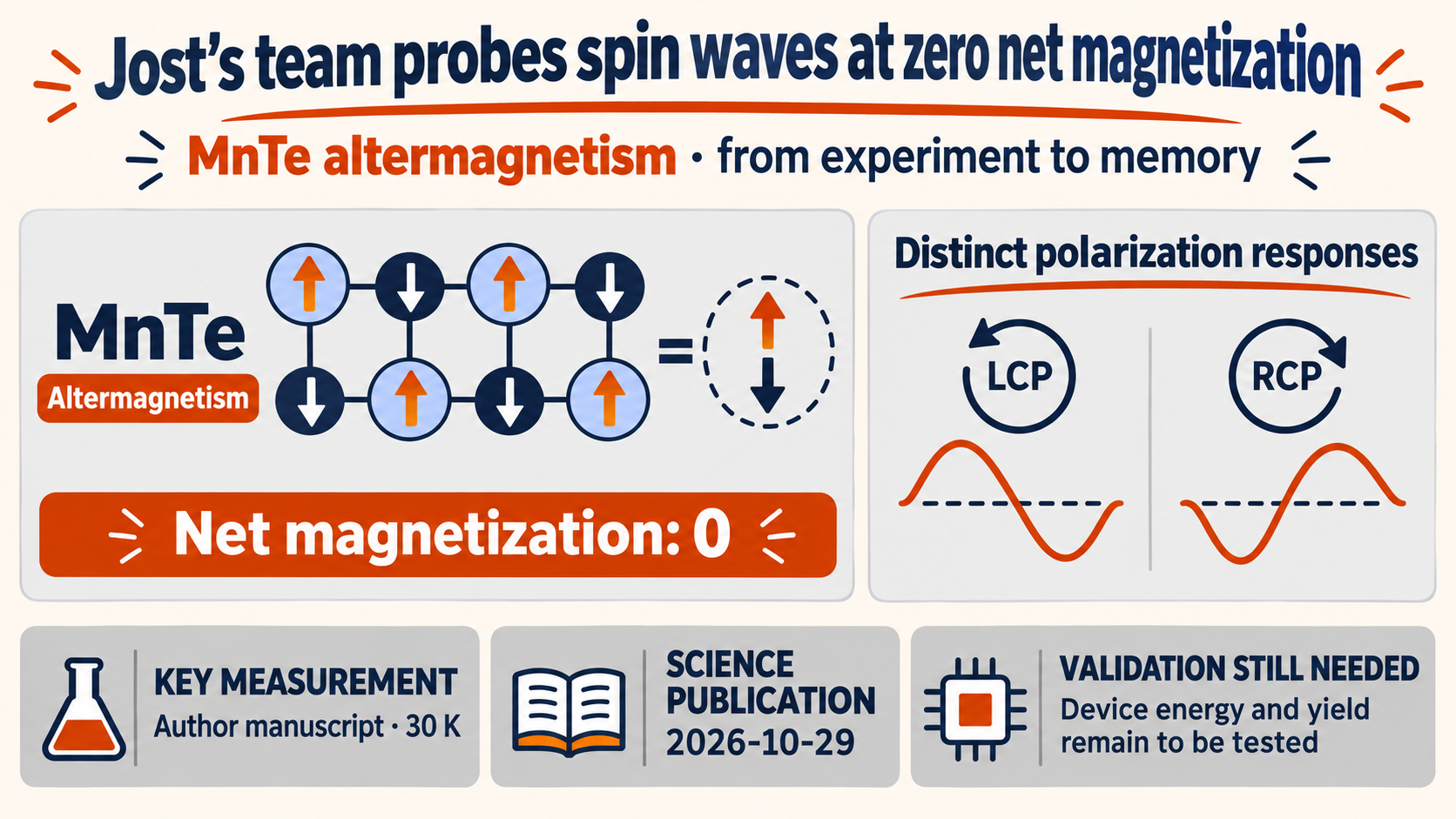
Daniel Jost at SLAC and an international team have reported important evidence for MnTe altermagnetism. A material whose magnetic moments cancel overall can still support collective spin motion with a distinct handedness. Their October 29, 2026 Science paper raises a practical question: what else must work before this physics can lower memory energy use and manufacturing costs? Source: PubMed: Science 논문 서지와 최종 초록
The attraction is the ability to distinguish spin information without a large overall magnetization. This is a materials experiment, however. It does not demonstrate a working chip with better power consumption or manufacturing yield.
Who is on Jost’s team, and who did what
Jost conceived the study, led the experiment and analyzed the data. Rachel Nickel helped design and carry out measurements at the ESRF ID32 beamline in France. Matthias F. Kling, a SLAC and Stanford coauthor, contributed to interpretation and the manuscript. Source: 저자 공개 원고: Chiral Altermagnon in MnTe Source: SLAC: Researchers find proof of altermagnetism
Sample preparation and calculations required complementary expertise. Resham Babu Regmi and Nirmal J. Ghimire at Notre Dame synthesized and characterized the samples. Eder G. Lomeli at Stanford and SIMES performed electronic-structure and atomic multiplet calculations. These roles come from the public author manuscript. Source: 저자 공개 원고: Chiral Altermagnon in MnTe
Jost was first author of a 2025 Physical Review X study on time-resolved X-ray spectroscopy. That work examined how electronic states respond to excitation. The MnTe experiment builds on the same broader expertise: using carefully controlled light to uncover otherwise inaccessible differences inside materials. Source: Stanford Profiles: Daniel Jost
MnTe altermagnetism: what survives zero net magnetization?
Spin is an electron’s quantum angular momentum. For a first picture, imagine tiny arrows. In a ferromagnet, aligned arrows produce an overall magnetization. In a conventional antiferromagnet, opposing directions cancel. Antiferromagnetism should not be confused with diamagnetism, a weak response opposing an applied magnetic field.
Altermagnetism combines compensated magnetic moments with spin-dependent electronic energies arising from crystal and spin symmetry. The difference depends on electron momentum. Zero overall magnetization therefore does not make the internal electronic states equivalent. Source: Šmejkal et al.: Altermagnetism, spin-momentum locked phase
Ferromagnetism
Nonzero
Net magnetization
Spin order · Aligned
Conventional antiferromagnetism
Compensated
Net magnetization
Spin states · Symmetry can enforce equal energies
Altermagnetism
Compensated
Net magnetization
Electronic energies · Momentum-dependent spin splitting
Jost’s team focused on collective spin motion, rather than directly remeasuring the electronic bands. Such motion forms a spin wave; its quantum is called a magnon. The question was whether the characteristic symmetry also appears when many spins move together. Source: PubMed: Science 논문 서지와 최종 초록
Why Nickel and Jost changed the handedness of X-rays
The team illuminated manganese telluride, or MnTe, with left- and right-circularly polarized X-rays. In circular polarization, the electric field rotates as the light travels. Comparing the scattered light tests whether the sample responds differently to the two handednesses. Source: SLAC: Researchers find proof of altermagnetism
CD-RIXS combines circular-dichroism measurements with resonant inelastic X-ray scattering: tune the incident energy to a resonance, then measure the energy lost by scattered photons. Chirality describes handedness. The published abstract reports a momentum-dependent spin polarization consistent with MnTe’s g-wave symmetry, a directional pattern rather than a device speed rating. Source: PubMed: Science 논문 서지와 최종 초록
The public manuscript places the key measurement at 30 K, about −243°C. It also leaves room for either a small energy splitting or different damping to explain unequal linewidths. Higher-resolution follow-up is proposed. Distinguishing polarization responses should not be reported as a definitive measurement of the energy gap between two modes. Source: 저자 공개 원고: Chiral Altermagnon in MnTe
Can moving less charge reduce operating costs?
Spintronics uses spin as well as charge for information processing. In a magnon-based approach, angular momentum can propagate without a net flow of charge along the signal path, potentially reducing resistive heating. Signal generation, detection and supporting circuitry still consume energy. Jost’s result provides a material-level foundation for investigating that trade-off. Source: SLAC: Researchers find proof of altermagnetism
The economic motivation is substantial. The IEA’s 2025 report put global data-centre investment in 2024 at roughly $500 billion. This historical figure is neither a MnTe market estimate nor a revenue forecast for suppliers. It illustrates why operators of expensive, heavily used infrastructure care about energy per operation. Source: IEA Energy and AI: Executive summary
Consider an illustration, not a measured result. Let total energy use equal 100. Suppose a new component affects 20% of consumption and halves that portion. Total use falls to 90 before overhead. Add 8 units for conversion circuitry or cooling, and it becomes 98. A 50% component saving has become a 2% system saving.
Not measured. Baseline 100; affected share 20%; component saving 50%; overhead 8. 100−20×0.5+8=98. · Axis starts at 85, not zero
Lower energy per operation could also increase throughput under an unchanged power limit. That improves productivity per machine, provided speed and error rates hold up. Operators might choose to do more work rather than cut electricity use. Lower bills and higher throughput are distinct benefits and should be counted separately.
A nearer opportunity in MRAM; a longer road to replacing DRAM
To connect Kling and Jost’s work to Korean industry, start with existing magnetic memory. MRAM reads information through resistance differences associated with magnetic configurations. Samsung announced commercial shipments of embedded MRAM on its 28nm FD-SOI process in March 2019. The company highlighted integration with existing logic manufacturing as an economic advantage. Source: Samsung: 28nm FD-SOI eMRAM commercial shipment
This establishes a real industrial base for spin-based technology. It does not mean Samsung uses this MnTe result. A new material must form uniform films, retain its properties at electrical interfaces and survive manufacturing temperatures. Cheap raw material can still produce an expensive chip if processing steps multiply or yields fall.
DRAM stores charge and periodically refreshes it. Replacing it requires competitive density, access time, endurance, error rates and price as well as energy efficiency. Jost’s paper does not report a memory-array benchmark covering those requirements. It provides no basis for calculating an immediate loss of DRAM sales or a change in MRAM market share.
A plausible earlier opportunity lies in research films, precision measurement, electrical control devices and design intellectual property. Companies pay to compare candidates and diagnose failures before volume production begins. Our CoSi interconnect article offers a related perspective on the gap between material performance and process economics.
What to look for next: temperature, reading and writing
The signal the team measured with synchrotron X-rays must eventually be generated and detected by much smaller electrical circuits. The three gates below are our commercial assessment framework, not a timetable announced by the authors: stability at operating temperature, lower end-to-end signal energy, and competitive manufacturing cost including yield.
-
1
Retain order
Validate at device operating temperatures
-
2
Write and read
Measure energy and errors including circuitry
-
3
Manufacture uniformly
Validate wafer yield, process cost and reliability
Temperature deserves particular attention. The public manuscript reports that the relevant signal disappears above the magnetic ordering transition near 310 K. This is not a finished product’s temperature specification, but it underlines the need for materials and structures that retain useful order in warm chips. Success in a cold measurement does not guarantee operation inside a server. Source: 저자 공개 원고: Chiral Altermagnon in MnTe
Korean research demand could follow these requirements: crystal growth and thin-film engineering, spectroscopy of spin states, and devices with practical read/write circuits. The paper does not establish an increase in Korean hiring; this is an assessment of skills needed if commercialization investment follows. Our attosecond X-ray article provides related context on measurement infrastructure in materials development.
Sensors and quantum devices are possible applications with different tests to pass. Sensors need suitable sensitivity and noise performance; quantum devices need controllable states that persist long enough. Potentially reduced magnetic interference cannot establish performance across every application.
Jost’s team has strengthened the experimental basis for distinguishing collective spin motion in MnTe. Economic value will come from selecting better devices and reducing actual operating energy and manufacturing costs. The most useful numbers in the next report will be operating temperature, energy per operation and yield.
Source scope: checked November 5, 2026. Final Science bibliographic details and the abstract were verified through PubMed. Detailed methods and contributions come from the public author manuscript, distinguished from the final publication. The cost example and Korean industry and workforce implications are conditional editorial analysis, not a recommendation to buy or sell any company’s shares.
The industrial value of spin waves must be tested in device energy and manufacturing yield.
Sources and further reading
- Šmejkal et al.: Altermagnetism, spin-momentum locked phase
- Science: Chiral altermagnon in MnTe
- PubMed: Science 논문 서지와 최종 초록
- 저자 공개 원고: Chiral Altermagnon in MnTe
- SLAC: Researchers find proof of altermagnetism
- Stanford Profiles: Daniel Jost
- Samsung: 28nm FD-SOI eMRAM commercial shipment
- IEA Energy and AI: Executive summary
For information only — this is not a recommendation to buy or sell any asset.
Comments 0