China trade surplus hits $1.04 trillion: what a 41.6% import jump means for Korea
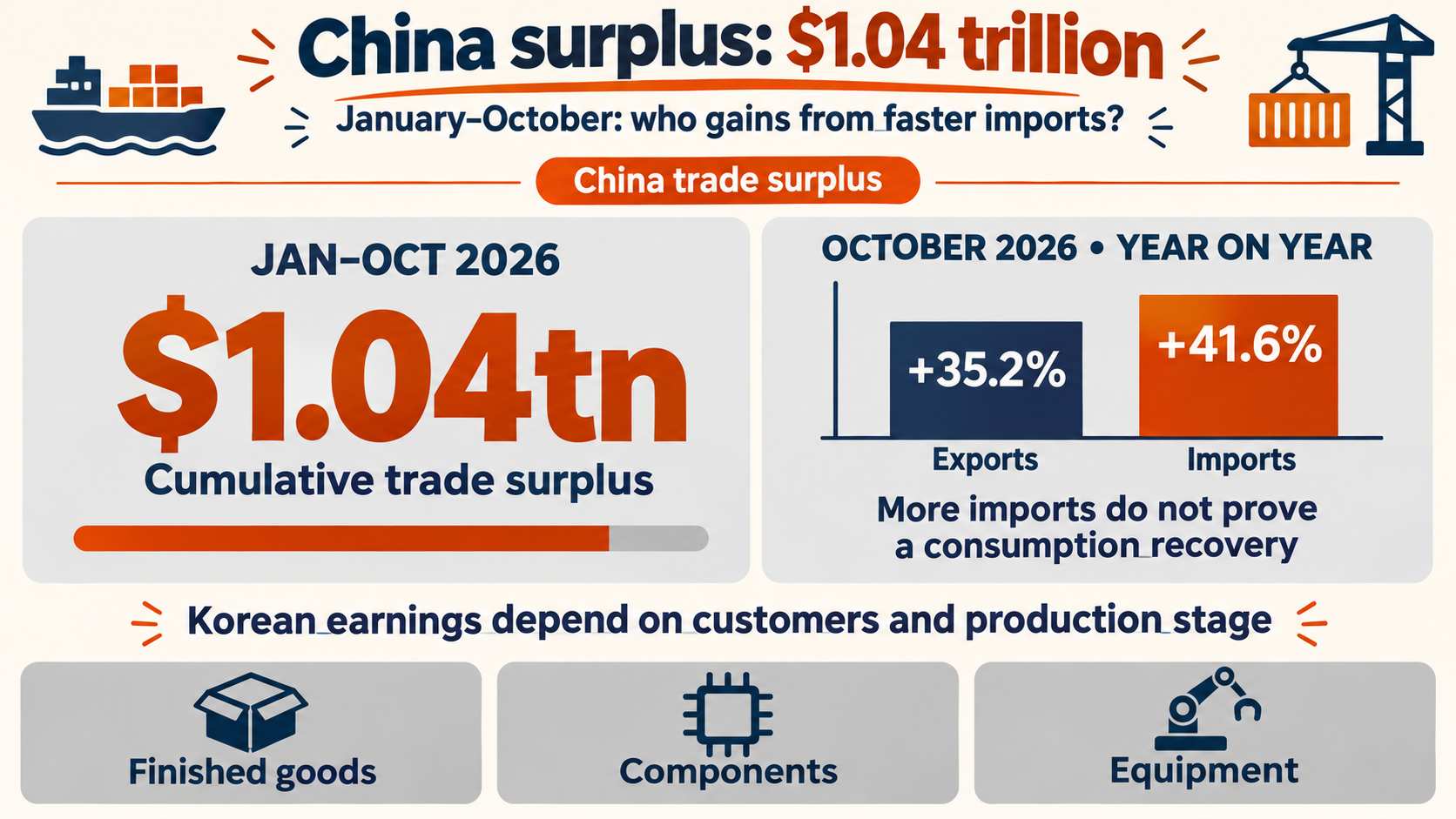
China’s trade surplus reached about $1.04 trillion in January–October 2026. Yet imports grew faster than exports in October. For Korean businesses, the question is also what China is buying—and who ultimately uses it. Source: AP 11월 10일
Reuters reported that October goods exports rose 35.2% from a year earlier in dollar terms, while imports increased 41.6%. Both sides of trade expanded. Treating this solely as a cheap-export story or a domestic-demand recovery misses the different earnings channels. Source: Reuters Source: IMF GMM 11월 10일
China trade surplus: growth rates and balances answer different questions
Faster import growth does not automatically eliminate a surplus. A trade balance subtracts import values from export values. Each growth rate, however, uses its own year-earlier base. A smaller flow can grow faster while remaining smaller.
October export and import growth. Goods values in USD. Reuters / IMF, Nov 10, 2026. Each series has its own base. · Axis starts at 32, not zero
The time window matters too. The $1.04 trillion figure covers ten months, not the full year. AP put October’s monthly surplus at about $105.3 billion. A narrowing monthly balance can coexist with a large accumulated surplus. Source: AP 무역수지 보도
These are nominal goods flows across borders. They are not the current account, which also includes services and other transactions, or inflation-adjusted growth. Higher export values alone do not establish falling Chinese prices or an equivalent rise in physical demand.
Does the import jump mean Chinese consumers are spending again?
Imports mean different things depending on their use. Finished goods bought by households point toward consumption. Chips imported for assembly into electronics that are exported again may instead reflect overseas orders. Factory activity and household spending need not move together.
The IMF’s November 10 market monitor identified technology inputs and crude purchases as contributors. ING’s same-day analysis distinguished rising crude import values from falling volumes. A larger import bill therefore need not mean more oil consumed by factories or households. Source: IMF GMM Source: ING 중국 무역 분석
Processing trade involves importing inputs, transforming or assembling them, and exporting the output. Bonded zones allow goods to be stored or processed under customs supervision with duties deferred. The concepts overlap but are not identical: a logistics inflow may also involve storage or preparation for re-export.
-
1
Inputs arrive
Distinct from final household consumption
-
2
Storage / assembly
Inventory time affects cash needs
-
3
Finished shipments
Foreign demand drives orders
Customs figures reported by People’s Daily Overseas on November 11 show January–October processing trade up 28.4% and bonded logistics trade up 44.1%. Both measure combined exports and imports in yuan, not October imports alone. Source: 인민일보 해외판
Jan–Oct growth in total trade by mode. People’s Daily Overseas, Nov 11. Combined exports and imports, not October imports.
For bonded logistics, follow arrivals with inventories and outbound shipments. Inputs that quickly enter production can support supplier earnings. Inputs left in storage tie up cash. The trade-mode source table could not be checked, so neither a precise bonded-import growth rate nor its AI share is asserted.
Korean firms face China as a market, production partner and competitor
A Korean company selling finished goods to Chinese consumers needs to watch retail sales and distributor inventories. Rising aggregate imports cannot substitute for demand for its own products. An input-led import boom need not lift consumer brands equally.
Memory and component suppliers to Chinese assemblers may gain orders. But customs clearance and revenue recognition can occur at different times under different contracts. Investors also need to separate higher selling prices from higher shipment volumes, then account for costs and customer pricing pressure.
Equipment makers may face an additional delay. Customers can first raise utilization at existing plants before buying more machines. Capacity shortages may eventually trigger expansion orders, but contracts, delivery and customer acceptance create a lag between stronger trade and reported profit.
Finished goods
Chinese end sales
Check
Risk · Weak consumption / price competition
Components
Volume and selling prices
Check
Risk · Inventory / order cancellations
Equipment
Expansion / acceptance
Check
Risk · Delayed capex
Korean producers competing with Chinese finished goods abroad may face pressure on selling prices. Within one company, a division can benefit from supplying China while another loses market share to Chinese rivals. China revenue exposure alone is therefore a poor guide to the net effect.
This connects with our earlier discussion of China’s manufacturing PMI and chip exports. Before treating strength in an export supply chain as a broad recovery, identify the industries and customers generating the orders.
Trade pressure before APEC: read the terms, not the meeting
A government report republished by Liaoning highlighted AI-related export strength. In a November 11 People’s Daily interview, Xu Yingming, director of international market research at the commerce ministry’s research academy, linked component imports to AI investment and recovering processing-trade orders. This interpretation does not quantify AI’s contribution. Source: 정부망 전재 Source: 쉬잉밍 인터뷰
In a November 10, 2026 report, ING Greater China chief economist Lynn Song expected AI-related trade to remain strong and identified APEC as a window to watch trade talks. This is a private-sector forecast. A meeting is not itself a tariff reduction or a purchase commitment. Source: Lynn Song·ING
At the December 10, 2025 China Article IV press conference, IMF Managing Director Kristalina Georgieva warned that continued export dependence in an economy of China’s size could intensify trade tensions. The IMF advocated a shift toward consumption. This is historical context, not a new response to October’s release. Source: IMF 게오르기에바 기자회견
Imported inputs that return abroad as finished products expand supply for overseas consumers, but can intensify price and employment pressure on competing producers. More final consumption in China creates a different channel, sending demand back to trading partners. The two forms of import growth do not mean the same thing in trade negotiations.
For Korean firms, product coverage, implementation dates and rules of origin matter alongside tariff rates. Barriers to Chinese finished goods could redirect orders to Korean competitors while reducing business for Korean suppliers to Chinese assembly plants. These are conditional channels, not company-specific earnings forecasts.
Sentiment and currencies: markets move before customs flows become earnings
CNN’s US Fear & Greed Index stood at 38.6, or Fear, on November 13: up 14.2 points from 24.4 a week earlier, but down 7.0 points from 45.6 a month earlier. GoldKimp’s KOSPI measure was 80.9, Extreme Greed, on November 12. Different methods and dates prevent a direct return forecast from this gap. Source: CNN Source: GoldKimp
US fear has eased over the week without recovering its month-earlier level. Korea’s reading is optimistic, but weekly and monthly comparison values for the KOSPI gauge were not available. Even favorable Chinese import news can disappoint stocks if investors have already priced in a larger earnings improvement.
SentimenTrader’s Smart Money and Dumb Money Confidence readings and their update date were not shown on the public page, so this article does not compare them. Source: SentimenTrader 공개 페이지
The trade surplus alone cannot determine currencies. Exporters’ conversion of receipts, foreign-currency holdings and capital flows also matter. A stronger won can reduce the translated value of dollar sales while lowering imported-input costs. The balance differs across companies.
What to check in the next earnings reports
The next questions are whether incoming components become finished shipments and whether those shipments become cash. Inventories rising faster than sales or slower customer payments can strain funding during a trade boom. Stable inventories and cash collection make expansion and hiring more feasible.
Follow the trade release with product-level quantities, prices and outbound flows by trade mode. In company reports, check order backlogs, inventories and operating cash flow. For APEC news, distinguish purchase intentions from implemented terms and imports already completed.
This extends our discussion of Korean exports and company profits. The useful signals are the final customer for China’s imports, the production stage served by each Korean firm, and the goods covered by trade restrictions. Those details determine earnings exposure. This article explains economic mechanisms and is not a recommendation to buy or sell an asset.
Source note: headline trade figures were cross-checked against Reuters, AP, IMF and ING material. They were not matched directly against the customs source tables, and trade-mode details follow People’s Daily Overseas. Historical statements and conditional analysis are labeled separately.
Sources and references
- Reuters, 2026-11-10 — 중국 10월 수출입
- AP, 2026-11-10 — 1~10월 중국 무역흑자
- IMF Global Markets Monitor, 2026-11-10
- ING Lynn Song, 2026-11-10 — Chinese trade continues to ride the global AI boom
- IMF Kristalina Georgieva, 2025-12-10 — China Article IV 기자회견
- CNN Fear & Greed — 2026-11-13 스냅샷
- GoldKimp KOSPI Fear & Greed — 2026-11-12
- SentimenTrader — 공개 페이지 확인
- 인민일보 해외판, 2026-11-11 — 무역방식 통계·쉬잉밍 인터뷰
- 랴오닝성 정부·중국정부망 전재, 2026-11-11
For information only — this is not a recommendation to buy or sell any asset.
Comments 0