Solidigm IPO Halt: Where Will U.S. Expansion Money Come From? Three Choices
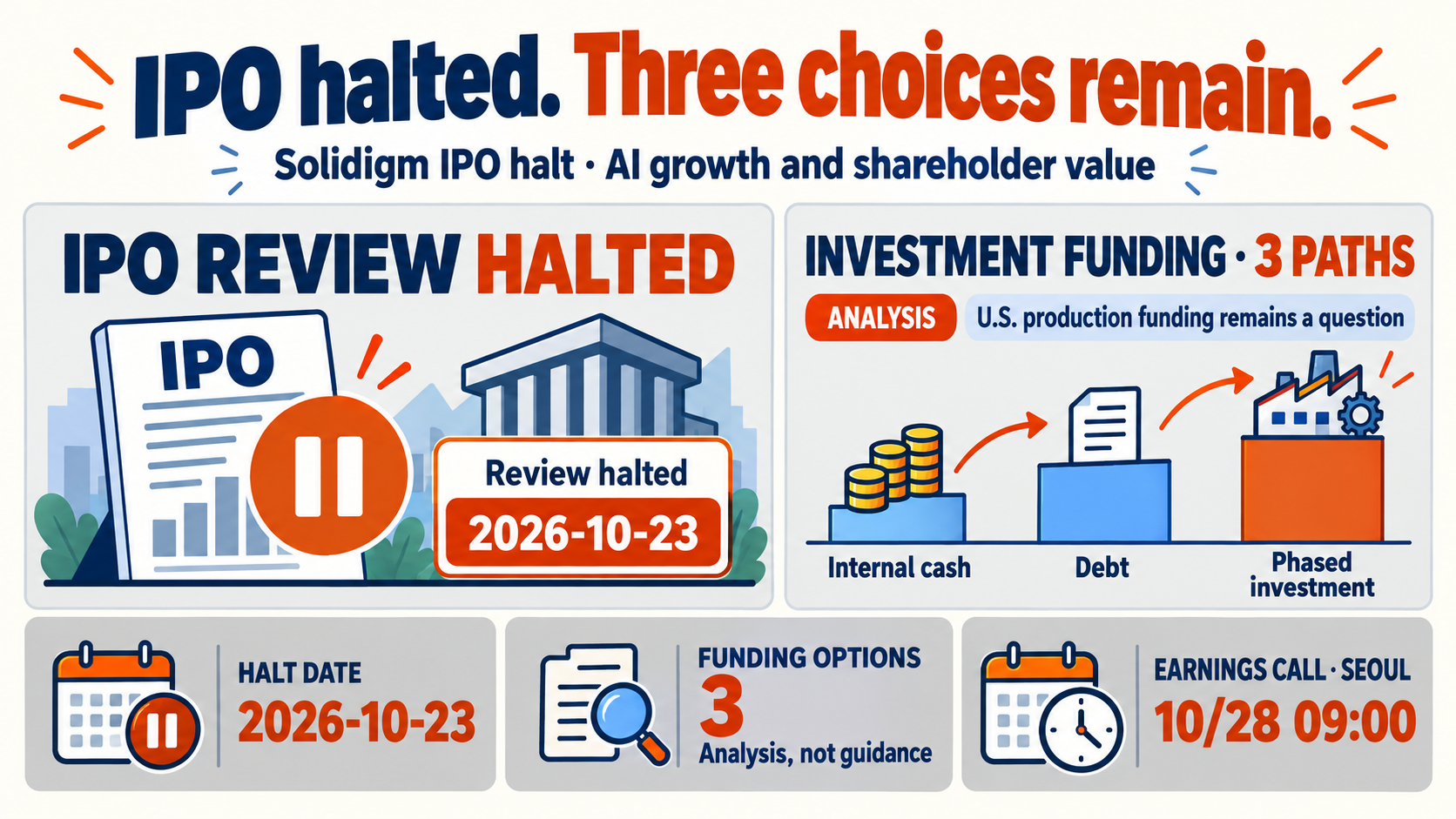
The Solidigm IPO halt removes a potential listing from consideration for now. It does not remove the need to finance production capacity. SK hynix’s October 23, 2026 announcement puts a practical question before shareholders: how should AI memory growth be funded? Source: SK hynix — Solidigm IPO 검토 중단 (2026-10-23)
Existing shareholders may welcome the decision, but financing choices still matter. More internal spending can compete with distributions. Borrowing creates interest obligations. Three broad alternatives help explain what investors should watch next.
What stopped—and what the announcement does not settle
The company discontinued its review of both pre-IPO fundraising and an IPO, citing capital-market and share-price conditions. It said alternatives for growth investment remain under consideration. That is not an announcement cancelling a fully specified factory project or withdrawing an AI demand forecast. Source: SK hynix — Solidigm IPO 검토 중단 (2026-10-23)
Yonhap separately reported shareholder opposition and regulatory concerns about overlapping parent and subsidiary listings. It also relayed the company’s position that tighter restrictions were not the direct reason. These are concurrent issues; the reporting does not establish a single cause. Source: Yonhap — SK hynix halts review of Solidigm U.S. IPO (2026-10-23)
An IPO can include newly issued shares, which bring cash into the company, or existing shares sold by their owners. Only the former directly funds the issuer. Without an offering structure, an IPO headline does not tell us how much money would reach the operating business.
A lower valuation makes the same funding more dilutive
Consider an illustration, not a Solidigm valuation. With a pre-money value of 100 and new funding of 20, new investors own 16.7% of the post-money value of 120. At a pre-money value of 60, the same funding buys 25.0%. This assumes a simple primary share issue and excludes fees.
New-investor ownership for the same funding of 20. Not Solidigm figures. New funding / post-money value; excludes fees.
Even a promising business may defer a listing when pricing is unattractive. It would surrender a larger share of future gains for the same cash today. Urgent funding needs or the cost of missing a capacity window can lead to the opposite decision. A halted listing alone settles neither the business outlook nor investment merit.
The supplied CNN snapshot shows a Fear & Greed reading of 20.0 on October 23, classified as extreme fear. It was down 2.1 points from a week earlier and 12.5 from a month earlier. That provides context for cautious IPO pricing; it is not evidence of an actual Solidigm bookbuilding result. Source: CNN Fear & Greed — 제공 스냅샷 2026-10-23
GoldKimp’s KOSPI sentiment reading was 71.2, or greed, on October 22. Comparable Korean readings for a week and a month earlier were unavailable. Different methods and dates also prevent a like-for-like comparison with CNN. Optimism in Korea does not guarantee attractive financing terms in the United States. Source: GoldKimp KOSPI Fear & Greed — 제공 스냅샷 2026-10-22
SentimenTrader’s homepage did not expose current values. The latest visible public repost showed Smart Money at 0.50 and Dumb Money at 0.49, both neutral, dated October 15. These are the provider’s sentiment measures, not institutional and retail net purchases. The older observation cannot establish positioning around the IPO decision. Source: SentimenTrader — 홈페이지 (동적 수치 미표시) Source: SentimenTrader 공개 게시물 재게시 — 2026-10-15 수치, TwStalker
Why AI demand creates a NAND investment question
NAND retains data without power. An SSD combines NAND with a controller and other components; eSSD denotes enterprise storage. Its role differs from HBM, which feeds data rapidly to processors. AI data centers need storage for training and retrieval data as well as memory close to computation.
On October 1, SK hynix described Solidigm’s focus on high-capacity enterprise SSDs for AI data centers. It also identified competing funding needs across HBM, server DRAM and eSSDs. Having internal cash does not by itself determine where that cash earns the best return. Source: SK hynix — Solidigm 자본조달 원칙 (2026-10-01)
Storage demand is only one driver of profitability. Customer qualification, selling prices, manufacturing yields and utilization all matter. Cash spending can precede revenue by a substantial interval. If capacity grows faster than demand, higher shipments can coexist with falling prices and weaker profits.
-
1
Capital outlay
Cash leaves first
-
2
Capacity and qualification
Yield and utilization
-
3
Sales and cash return
Pricing and costs determine returns
The halt therefore does not imply an immediate reduction in U.S. NAND supply. The announcement does not finalize the new facility’s size, location or production date. A budget for a separate HBM packaging project cannot be substituted for Solidigm’s financing requirement. Source: SK hynix — Solidigm IPO 검토 중단 (2026-10-23)
Why regulators are scrutinizing duplicate listings
At an October 19 parliamentary audit, FSS Governor Lee Chan-jin discussed duplicate-listing scrutiny and a pending interpretation of domestic filing requirements, according to BusinessWatch. On October 22, FSC Chairman Lee Eog-weon said the guidelines applied. Asia Economy also reported that the specific scope and filing obligations depended on the transaction structure. Source: 비즈워치 — 이찬진 금감원장 국감 발언 (2026-10-19) Source: 아시아경제 — 이억원 금융위원장 국감 발언 (2026-10-22)
The economic issue is who benefits after financing, not simply whether capital is raised abroad. The price paid for an ownership stake and the share of subsequent earnings retained by existing investors both matter. These reported comments should not be expanded into a definitive legal ruling on an unspecified transaction.
A holding-company discount means a parent trades below an assessed value of its underlying assets. A separately traded subsidiary gives investors another route to the business. Parent debt, overhead, upstream dividends and confidence in capital allocation influence that choice. A listing need not deepen a discount, and halting one does not automatically eliminate it.
Exposure through SK hynix is different from exposure through SK Square or SK Inc. Ownership stakes, other assets, debt and distribution policies differ at each level. Treating the group as a single stock risks counting the same underlying business more than once. Source: Yonhap — SK hynix halts review of Solidigm U.S. IPO (2026-10-23)
SK hynix’s July 29 release emphasized staged expansion tied to demand and investment efficiency, alongside financial health. This connects with our earlier discussion of AI investment and financing. A long-term growth case does not remove the near-term funding burden for suppliers. Source: SK hynix — 2Q26 실적 및 설비투자 원칙 (2026-07-29)
Three alternatives: internal cash, debt and investment pace
Internal cash preserves ownership and avoids new contractual interest. But money spent on capacity is unavailable for another product line, dividends or share repurchases. Its cost is the return forgone elsewhere.
Debt preserves ownership but leaves interest and maturity obligations even if demand disappoints. Dollar borrowing can better match dollar revenue and spending. Maturity mismatches, parent guarantees and hedging costs still require scrutiny.
Dollar bond financing generally combines a Treasury benchmark with compensation for company credit risk. Our discussion of Treasuries and dollar asset pricing explains the broader rate channel. A particular auction yield is not Solidigm’s actual borrowing rate.
Phased investment can reduce early cash outlays and excess-capacity risk as orders and product qualification become clearer. Delaying too far can surrender business to competitors. Customer-linked funding or partnerships are analytical possibilities, not announced replacement plans.
Internal cash
Ownership retained; no new interest
Benefit
Trade-off · Less room for other uses
Debt
Funding without equity dilution
Benefit
Trade-off · Interest, maturity and guarantees
Phased investment
Lower initial spending and excess capacity risk
Benefit
Trade-off · Delay and lost customer opportunities
On August 19, SK hynix announced a KRW 40 trillion repurchase-and-cancellation resolution and a move toward returns exceeding 50% of cumulative 2025–2027 free cash flow. FCF broadly tracks cash remaining after operating cash generation and capital spending. An announced program should be distinguished from completed execution. Source: SK hynix — 자사주 매입·소각 및 주주환원 계획 (2026-08-19)
IPO proceeds from new shares are financing cash, not operating profit. More consolidated cash does not mean the business generated more cash from customers. Factory spending affects cash first; depreciation and operating performance later affect earnings. The halt therefore produces no automatic increase in earnings per share or dividends.
What the next disclosure needs to answer
Outcomes depend on execution. If eSSD demand and pricing hold while spending stays disciplined, internal funding may retain more future gains for existing shareholders. If demand weakens while debt and capacity rise, interest, depreciation and low utilization can squeeze profits. These are scenarios, not reported results.
For Korean equipment and materials suppliers, vendor selection and actual purchase orders matter more than the announcement alone. U.S. construction does not translate directly into Korean household income. Domestic production, R&D and procurement determine that transmission. More storage capacity could eventually lower costs, but this decision alone cannot predict consumer SSD prices.
In markets, reduced listing concerns should be separated from broader semiconductor risk. Korean chip ETFs respond to multiple companies, earnings expectations and investor flows. Favorable governance news at one business can be outweighed by weaker memory pricing or AI spending expectations.
The next scheduled checkpoint is the company’s earnings call at 9 a.m. Seoul time on October 28. Watch for the scope and timing of U.S. investment, the funding mix and actual shareholder-return execution. Retaining a growth business and financing its expansion on attractive terms are separate tasks. Source: SK hynix — 3Q26 실적 발표 초청장 (2026-10-21)
This article uses announcements through October 23, 2026 and the supplied market snapshot. Illustrations and conditional scenarios are analysis, not company guidance or a recommendation to trade a security.
Sources and references
- SK hynix — Solidigm IPO 검토 중단 (2026-10-23)
- Yonhap — SK hynix halts review of Solidigm U.S. IPO (2026-10-23)
- SK hynix — Solidigm 자본조달 원칙 (2026-10-01)
- SK hynix — 자사주 매입·소각 및 주주환원 계획 (2026-08-19)
- SK hynix — 2Q26 실적 및 설비투자 원칙 (2026-07-29)
- 비즈워치 — 이찬진 금감원장 국감 발언 (2026-10-19)
- 아시아경제 — 이억원 금융위원장 국감 발언 (2026-10-22)
- SK hynix — 3Q26 실적 발표 초청장 (2026-10-21)
- CNN Fear & Greed — 제공 스냅샷 2026-10-23
- GoldKimp KOSPI Fear & Greed — 제공 스냅샷 2026-10-22
- SentimenTrader — 홈페이지 (동적 수치 미표시)
- SentimenTrader 공개 게시물 재게시 — 2026-10-15 수치, TwStalker
For information only — this is not a recommendation to buy or sell any asset.
Comments 0